


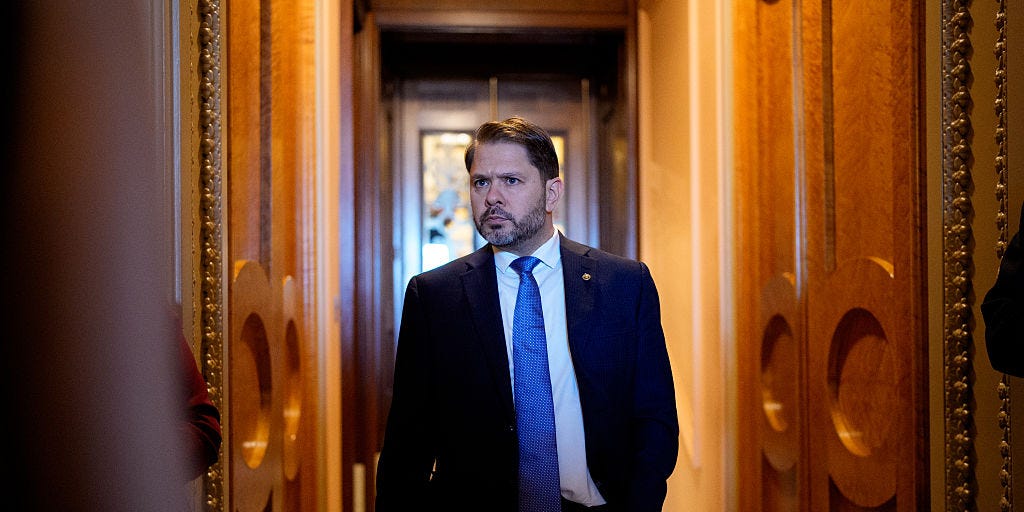
TODAY, SENATORS RUBEN Gallego (D-AZ) and Roger Marshall (R-KS) made a move they’re hoping can improve men’s health in the US.
This morning, they introduced the bipartisan State of Men’s Health Act in the Senate. This is the legislation that would set up an Office of Men’s Health and require a study from the Government Accountability Office on the state of men’s health. We already know that since 2016, the life span gender gap has expanded from 4.4 years to 5.9. The current average age of death for men is 73.2 years, while for women, it’s 79.1. So the office wants to figure out what’s going on with the aim of coordinating resources to figure out what to do about it.
An Office of Women’s Health already exists—it connects different offices to each other to coordinate research, education, and policy developments—and the idea is that the Office of Men’s Health would do a similar thing. The House version of the act was introduced earlier this year. We tapped Sen. Gallego—a former Marine and a champion of veteran health care and men’s mental health—to explain more about what all this might actually be able to do.
MH: What do you hope the Men’s Health Act will accomplish?
RG: There are a lot of ways we are really falling behind when it comes to men’s health in this country. Men are facing a growing health crisis and dying earlier from preventable conditions like cancer, heart disease, and mental health struggles. Instead of letting men continue to struggle alone in silence, this bill would establish an Office of Men’s Health to promote preventive care and life-saving research. When we invest in men’s health, we build stronger families and stronger communities.
MH: If so much of the health research that already exists has been done in men, then what do you think an Office of Men’s Health will do?
RG: The Office of Men’s Health will actually be able to bring some of that information that’s already out there and gather it and spread it to doctors, nonprofits, PR campaigns, and to men so they can be able to understand what they should be doing. There is still a lot of research that needs to be done on longevity for men, whether it’s dealing with heart disease or weight gain.
You know, we have this president and vice president and secretary of defense that are very worried about testosterone. Those are conversations we should be having in a very scientific manner. And I think men should get information that is scientifically based and not just necessarily coming from influencers.
And there’s not actually enough research and resources put into male mental health, and this is why you’re seeing an increase in suicide rates. We can’t actually say things are going well with the health of men in this country.
MH: Versions of this bill have been introduced before. What gives you hope for this one?
RG: I think there is a growing recognition that there is an issue with the men in this country when it comes to their health and to mental illness. In order for you to have a healthy society, you need to have healthy men—both physically and mentally. And we need to actually make that investment for that to happen.
MH: If this is successful, what does it look like for the average American guy in one year, 5 years, and 10 years?
RG: I think in one year you would actually see the government being organized and doing research into the status of men. Where are we failing them? Where are we seeing the largest increase in terms of mortality when it comes to men? What can we do in terms of changing the environment or changing the inputs that can stop these men from having certain types of cancer? A lot of the problems we have are because we haven’t measured them. So a lot of it is going to be first measuring the problem, then finding the solutions, then trying to figure out how to push out the solutions.
MH: In this world where we can’t agree on anything, how did you get bipartisan support?
RG: I want to be a good father, I want to be an active grandfather, and I think there’s a very bipartisan understanding of that. That’s not a Democrat or Republican value. I think we want to be good fathers. We want to be involved in our community, and we don’t want to be a burden to the community, and by us being able to take care of ourselves, we can be responsible leaders of our family.
I think for too long, Democrats have been avoiding talking about men and really having a focus on men. And I think that has potentially stopped some of this legislation from moving forward. I think we should be taking care of all Americans—male, female, and of all races. Growing up without a father and really learning to be a man—both taking care of myself and my family—has been a very difficult struggle for me. I would have been better off having this kind of information available.

Marty Munson, currently the health director of Men’s Health, has been a health editor at properties including Marie Claire, Prevention, Shape and RealAge. She’s also certified as a swim and triathlon coach.
Read the full article here