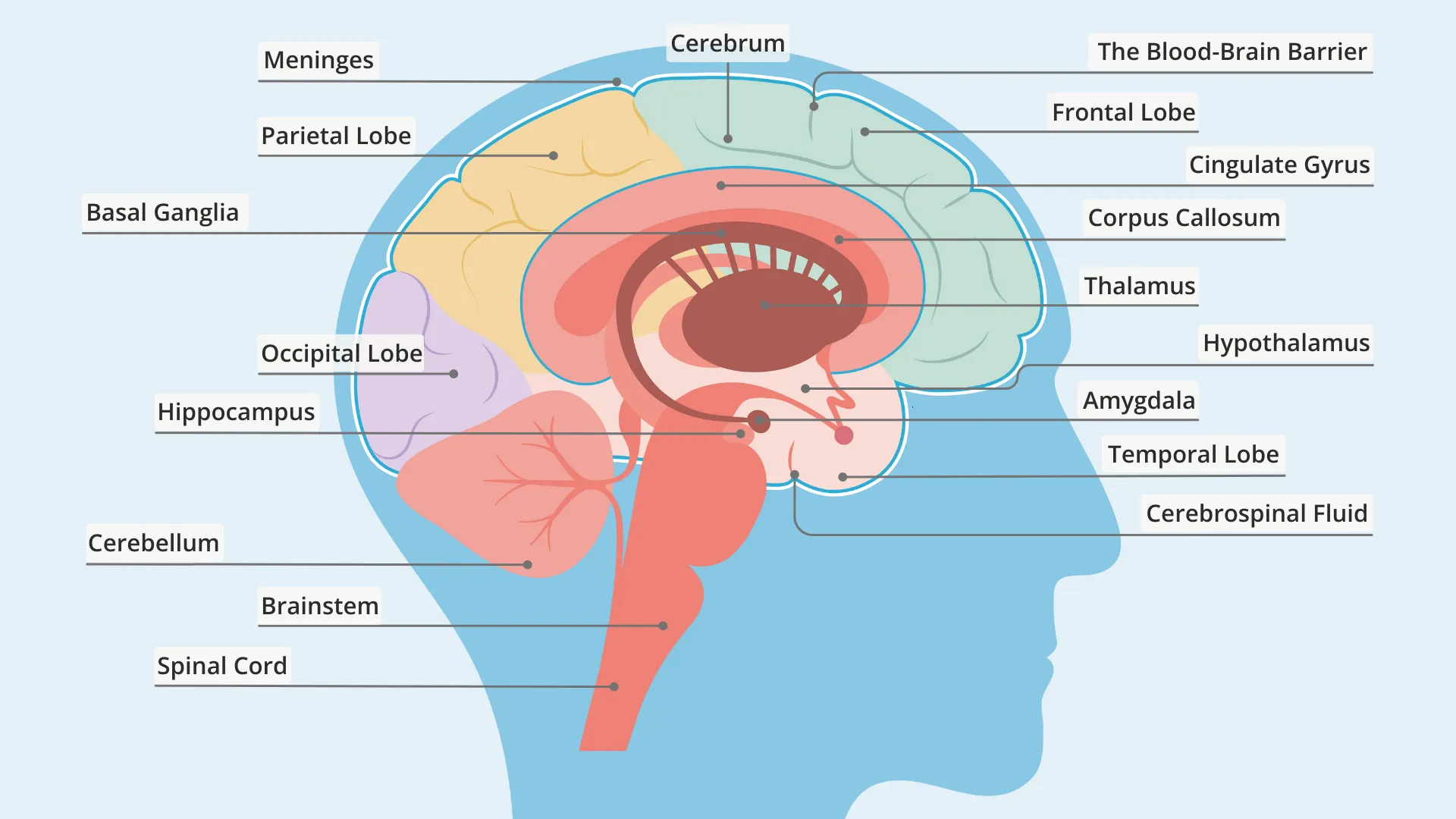
“To better understand the anatomy of the brain, it can be subdivided into three parts: the cerebrum, cerebellum, and the brainstem, with the basal ganglia and diencephalon as connecting stations between these,” Dr. Komisarow says.
The Cerebrum
The largest (and perhaps the most famous) part of the brain is the cerebrum, says Komisarow. The cerebrum makes up about 80 percent of the brain.
“When most people think of ‘the brain’ they are thinking of the wrinkles of gray and white matter of the cerebrum,” he says.
Located in the front of the brain, the cerebrum is covered with gray matter, called the cerebral cortex, with white matter at the center.
The cerebrum is where thinking is done, and also where we start actions, like speaking to our friends or processing what our senses take in, says Komisarow.
Functions of the cerebrum include initiating and coordinating movement, temperature, touch, vision, hearing, judgment, reasoning, problem solving, emotions, and learning.
The cerebrum is divided into two halves, the left and right cerebral hemispheres, which are connected and communicate through a large C-shaped structure of white matter (nerve fiber bundles), called the corpus callosum.
The right side of your cerebrum controls movement on the left side of your body and the left side of your brain controls the right side. That means when one side of the brain is damaged, the opposite side of the body is affected. For example, a stroke in the right hemisphere of the brain can leave the left arm and leg paralyzed.
For most people, the left brain hemisphere is dominant; most people who are right-handed are left hemisphere dominant. And most people who are left-handed are right hemisphere dominant.
The dominant hemisphere is responsible for speech and language functions, and the non-dominant is responsible for your spatial awareness and processing what you see.
The Cerebellum
The cerebellum is a fist-size portion of the brain located at the back of the head, below the temporal and occipital lobes and above the brainstem. It also has two hemispheres, and the outer portion contains neurons, and the inner area communicates with the cerebral cortex.
“It is largely involved in balance and coordinated movement,” says Komisarow.
The cerebellum also assists in cognitive functions such as attention, language, pleasure response, and fear memory.
The Brainstem
The brainstem is the part of the brain that connects the “upper parts” — the cerebrum and cerebellum — with the spinal cord, says Komisarow. It includes the midbrain, the pons, and the medulla.
“It contains a lot of important centers that control bodily functions that occur automatically, like breathing,” Komisarow says.
Respiration, heart rate, wake-sleep cycles, coughing, sneezing, digesting food, and vomiting are all housed in the brainstem.
The midbrain portion of the brainstem facilitates hearing and movement and responses to changes in our surroundings. It also contains the substantia nigra, an area rich in dopamine neurons that is affected by Parkinson’s disease.
The brainstem also plays a role in some functions we do control, such as eye movements and swallowing, says Komisarow.
The Diencephalon
The diencephalon is the term for a group of brain centers located in the middle of the brain at the core of the cerebrum, says Komisarow.
The best known of these is the thalamus, which makes up about 80 percent of the diencephalon.
“It serves as a sort of relay station for information from your senses and for planned movements, and it plays an important role in being awake and alert,” Komisarow says.
The hypothalamus also resides here, and the structure is the main link between the endocrine system and the nervous system. It produces hormones that control body temperature, heart rate, mood, sleep, hunger and satiety, and sex drive.
The epithalamus houses the pineal gland and regulates circadian rhythms by secreting melatonin, which helps the body adjust to the light-dark cycle. It also helps the body regulate emotions and conserve energy.