


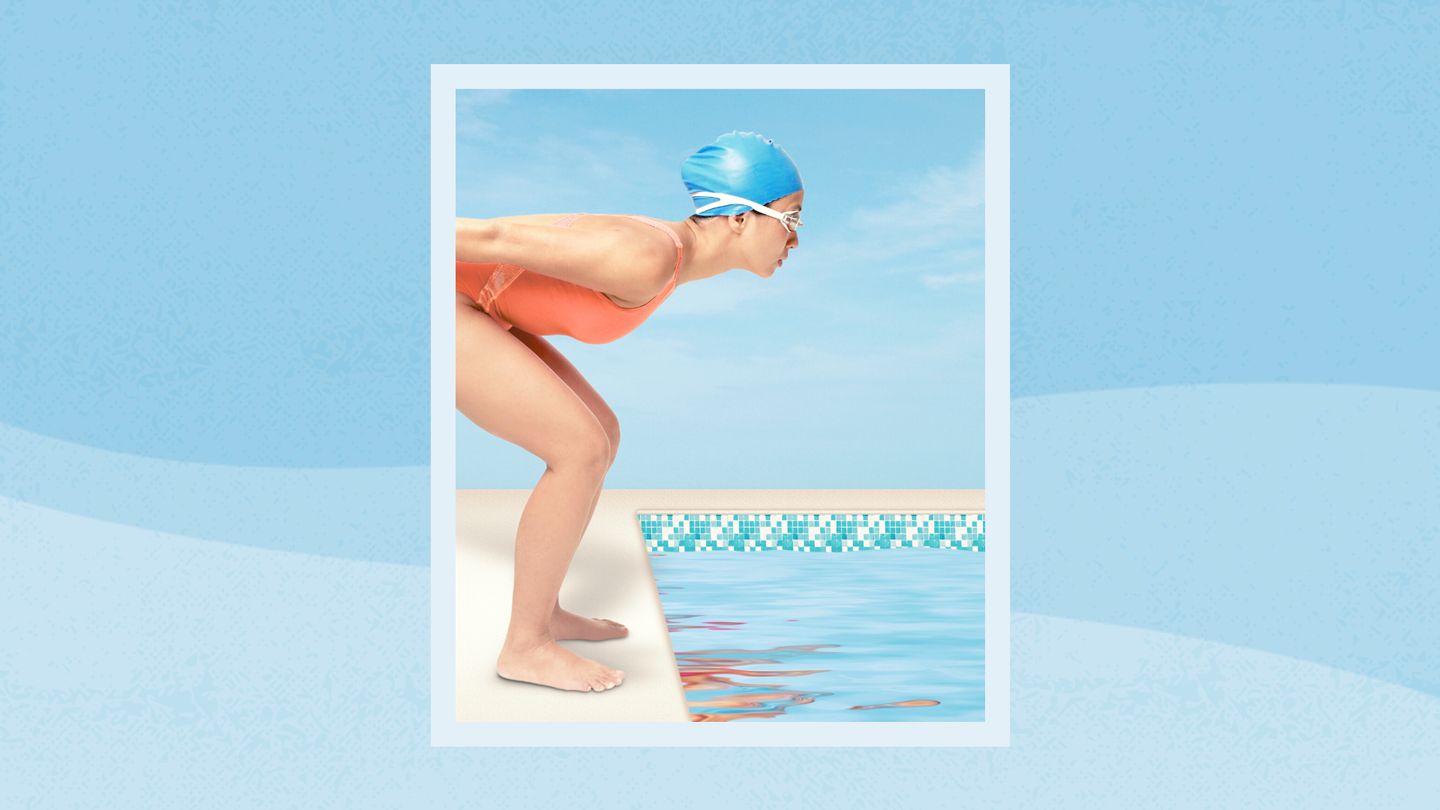
If you haven’t been swimming for a while (or don’t know how to swim), work with a learn-to-swim instructor to build or refresh your skills. “That’s always a good first step just to gain confidence in what you’re able to do,” says Kristopher Gagne, a USA Swimming–certified swim coach in Houston.
Once you’re ready to begin training on your own, shoot for two to three (up to four) swim workouts per week. Give yourself a day off between sessions so your body has time to recover before swimming again.
Odds are you won’t be able to swim the entire workout nonstop — and that’s okay. Gagne recommends breaking up each workout into intervals. After a warmup, swim 25 yards (the length of a standard pool), and rest until you feel ready to go again. Repeat that for four total intervals during your first workout. “Then, each subsequent workout in the pool, add two to four laps,” Slabaugh says.
To pace yourself, aim to work at an intensity that gets your muscles warm and heart rate up, but isn’t so challenging that you can’t complete the workout. Think no more than a 5 on a scale of 1 to 10, Gagne says, where one is the equivalent of sitting still, and 10 is an all-out sprint.
As you gain strength and fitness, you’ll be able to swim for longer intervals before taking a break. For the first month, however, just focus on your technique and doing the workouts the best you can.
Supplement your swimming with two days of strength training per week, focusing on all the major muscle groups (including the abdominal and core, arm and upper body, and glute and other leg muscles), Gagne says. (Or if you prefer, strength train up to four days per week, adding 20- to 30-minute strength training sessions before your lap workout.)
Week 1
Day 1 Swim 25 yards, rest; repeat 4 times total
Day 2 Strength train, 30 to 45 minutes
Day 3 Swim 25 yards, rest; repeat 6 times total
Day 4 Strength train, 30 to 45 minutes, or rest
Day 5 Swim 25 yards, rest; repeat 8 times total
Day 6 Strength train, 30 to 45 minutes
Day 7 Rest
Week 2
Day 1 Swim 25 yards, rest; repeat 10 times total
Day 2 Strength train, 30 to 45 minutes
Day 3 Swim 25 yards, rest; repeat 12 times total
Day 4 Strength train, 30 to 45 minutes, or rest
Day 5 Swim 25 yards, rest; repeat 14 times total
Day 6 Strength train, 30 to 45 minutes
Day 7 Rest
Week 3
Day 1 Swim 25 yards, rest; repeat 16 times total
Day 2 Strength train, 30 to 45 minutes
Day 3 Swim 25 yards, rest; repeat 18 times total
Day 4 Strength train, 30 to 45 minutes, or rest
Day 5 Swim 25 yards, rest; repeat 20 times total
Day 6 Strength train, 30 to 45 minutes
Day 7 Rest
Week 4
Day 1 Swim 25 yards, rest; repeat 22 times total
Day 2 Strength train, 30 to 45 minutes
Day 3 Swim 25 yards, rest; repeat 24 times total
Day 4 Strength train, 30 to 45 minutes, or rest
Day 5 Swim 25 yards, rest; repeat 26 times total
Day 6 Strength train, 30 to 45 minutes
Day 7 Rest
The Takeaway
Swimming is a low-impact activity that is easier on your joints than other forms of exercise while still providing a full-body workout. If you’re just starting out, ease into swimming with slow, steady intervals, and gradually build up to help reduce muscle soreness and the risk of injury. Add safety to your workout routine by swimming with a friend or in a pool with a lifeguard on duty. Always check with your healthcare provider before starting an exercise program.
Read the full article here