







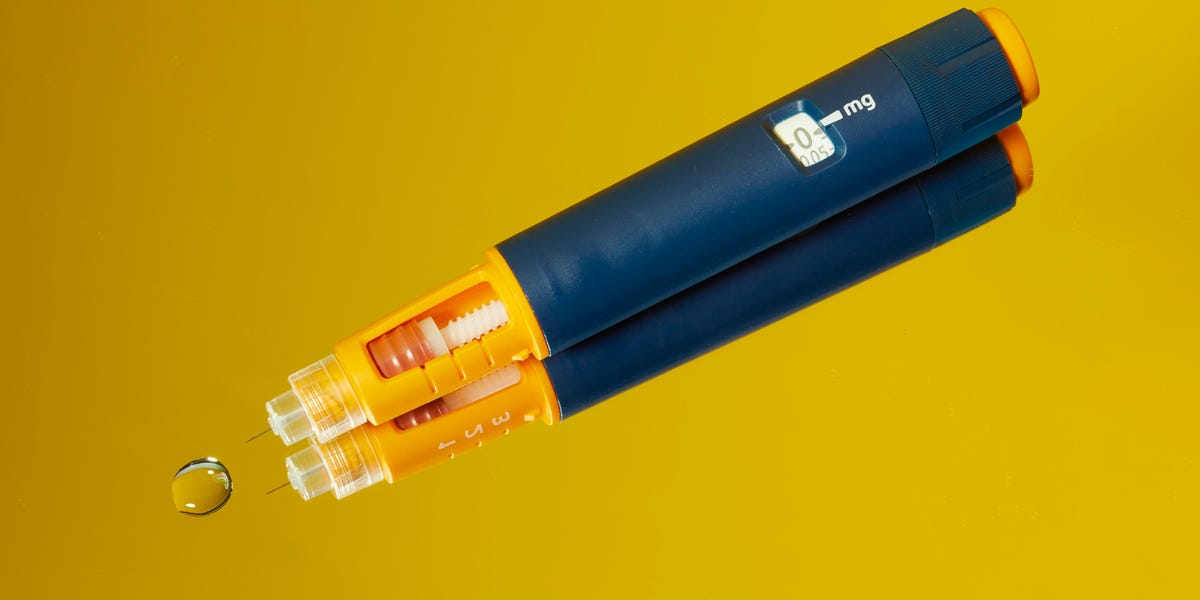
With so much chatter about GLP-1 drugs everywhere right now, it may be hard to believe that Ozempic (aka semaglutide) only came on the scene in 2017 to treat type 2 diabetes. It wasn’t until 2021 that Wegovy, another GLP-1 (glucagon-like peptide receptor agonist) was approved specifically for weight loss.
Since then, the GLP-1 space has exploded with the rise of tirzepatide (which is a GLP-1 and GIP, gastric inhibitory polypeptide receptor agonist) and the soon-to-launch retatrutide, a triple agonist. There’s also a GLP-1 pill that just hit the market, with more likely to follow quickly. In short, there’s a lot going on here and it’s hard to keep up with it all.
Here’s what men should know about the GLP-1 landscape today.
What are GLP-1s and what do they do?
These medications mimic a natural hormone that we release after we eat, explains Jyotsna Ghosh, M.D., an obesity medicine physician at Johns Hopkins Medicine. These receptors are in the digestive system and brain, so targeting them can change our hormone balance, helping to increase satiety after a meal and reduce the speed at which nutrients move through the digestive tract. “It’s going to make a difference in how our whole body functions on a cellular level,” she says.
As you no doubt know by the blizzard of ads and conversations about them, there’s more than one option when it comes to GLP-1s. Tirzepatide, as mentioned above, is a dual GLP-1 and a GIP receptor agonist, meaning it works on two different hormone receptors in the body. Because of this, tirzepatide is more effective for weight loss: studies are showing semaglutide delivering about 15 percent weight loss and tirzepatide delivering closer to 20 percent, Dr. Mehal says.
On the horizon is retatrutide. In addition to being a GLP-1 and GIP receptor agonist, “reta,” as it’s coming to be known, activates a hormone called glucagon that’s released by pancreatic endocrine cells. And—no big surprise—it’s been shown in initial trials to be even more effective than semaglutide or tirzepatide, bringing an average weight loss of close to 25 percent, says Wajahat Mehal, M.D., director of the Yale Weight Loss Program. “To lose a quarter of your body weight is a tremendous amount of weight,” he says. “Retatrutide promises to be a very good drug.”
What can these medications do for our health?
Beyond weight loss and all the associated benefits that come with that (such as less joint pain), these medications can treat metabolic diseases including type 2 diabetes, sleep apnea, fatty liver disease and coronary artery disease.
Dr. Ghosh says that while her female patients are more likely to come in for a diagnosis of overweight or obesity alone, her male patients often wait until they have another health condition at play. The good news is that with GLP-1s, she can treat both obesity/overweight and these associated metabolic diseases. “If we’re targeting lifestyle and using the right metabolic tools, whether that’s medication or whatever tool we’re using, everything’s going to get better,” Dr. Ghosh says. Often, it happens quickly.
What are the side effects of weight loss drugs?
As with any medication, GLP-1s come with their fair share of potential side effects. Dr. Ghosh says that men may be slightly more susceptible to certain side effects than women. “This is one of the only drug classes that have been studied where that’s the case,” she says. “And that especially seems to be true in women who have had a pregnancy [being] less susceptible to side effects (especially nausea) with the medications.” Men tend to have a little bit more nausea and constipation while getting started on these medications, she says.
Otherwise, side effects are pretty similar among the drug’s takers. The most common one that she sees is fatigue. On the lesser-known end of the spectrum is anhedonia, or a loss of pleasure. “This is a really interesting one because for things like exercise, this can happen,” she says. These two side effects can be a one-two motivation punch in the gut: “I’ve seen this too where people are fatigued and they’re not getting the same endorphin rush that they used to get with the exercise,” Dr. Ghosh says, adding that it’s important to track these symptoms over time and report them to your doctor who may consider changing up your dose or the type of medication you’re on.
Muscle loss is another common side effect but doctors are quick to point out that this is not specific to medications; it happens with any significant weight loss. The amount varies a lot, but between 10 and 20 percent of the weight people lose could be muscle, Dr. Mehal says, pointing out that this can be mitigated through exercise. “Doing weight training and eating enough protein—that can really change the percentage muscle mass reduction over time,” Dr. Ghosh says.
When it comes to gut side effects, all meds might not be the same. The newer drugs come with less severe and less prevalent digestive side effects, both doctors report. Dr. Mehal says that this is thanks to the fact that tirzepatide works on two receptors. “Tirzepetide is predominantly an agonist for the GIP receptor, and that pathway induces less nausea,” he says.
What to Know About GLPs and Erectile Disfunction
“I do get asked about [ED] because some of the older generations of weight management medicines, like phentermine, tend to have a lot of urinary side effects, especially for males,” she says. But in the case of GLP-1s, they might actually help with erectile function: “If anything, it should help with blood flow, vascular distribution, and turning down inflammation, helping all the systems function better,” she says.
Dr. Mehal agrees that these drugs could improve ED, especially because the condition is strongly associated with obesity and diabetes and other metabolic conditions with men as young as their early 50s reporting ED. “As those conditions improve,” ED improves, he says.
There’s also some initial data showing increased availability of free testosterone thanks to these drugs, as well as improved sperm quality, though data is mixed. More research is needed, but Dr. Mehal says that it tracks that eliminating diabetes would help improve health issues, possibly fertility-related ones included. Still, some people do report a lower libido and less sexual desire (versus function), which is connected to anhedonia, Dr. Ghosh says.
What if I don’t like the idea of injections?
The Wegovy pill just hit the market early this year and some patients are excited for an option that’s not an injectable, says Dr. Ghosh. “I have some people who like the ease of the injection and having something once a week and I have some people who are very routine and it’s easier for them to start every day with the pill.”
The downsides of the pill are that it must be taken at the same time every day on an empty stomach, and it’s slightly less effective, Dr. Mehal says. “The oral drugs are coming in usually at the low teens, 11 to 13 percent weight loss, and their nausea profile is worse than tirzepatide,” he says.
At the end of the day, it’s largely a personal choice between the pill and injectible, both doctors say. “It gives people the autonomy to choose what makes the most sense for them,” Dr. Ghosh says.
How much do GLP-1s cost?
The costs can vary widely depending on your insurance coverage and other factors, but the good news is that as this space continues to grow, the prices will likely continue to come down, Dr. Mehal says.
Dr. Ghosh agrees: “Hopefully as there are more options in the market, especially for people who don’t have insurance coverage, that will drive the price down as there’s more competition for our cash pay patients or self-pay patients,” she says.
This may have the added benefit of making it easier for people to get more regulated medication. “I’m hoping that as there are more affordable options for people, they’ll be able to choose things that are regulated, that they know exactly what they’re getting, that their doctor is able to prescribe so that they don’t have to pay outside of insurance for another subscription model membership for a telehealth company or all of these extra costs that keep accumulating for people just to try to optimize health,” Dr. Ghosh says.
What happens when you stop taking GLP-1s?
“Clinical trials suggest that this is a lifelong treatment,” Dr. Ghosh says, although she has seen patients successfully transition to other classes of medicines for maintenance. “It depends on someone’s specific biochemistry and their lifestyle, behavioral, and environmental plans,” she says.
Typically, though, if someone is doing well with a metabolic medication on board, it’s best as a “chronic treatment” though she may adjust the dosing. “As the body mass comes down, the concentration of the medicine in the body goes up, and so a lot of people don’t necessarily need the same dose for maintenance that they needed to achieve a certain weight,” she says. “So I have lots of people who successfully taper over time.” More research is needed, but for now, it’s relatively trial and error to figure out what works best for a particular patient, not unlike diet. “We have guidelines around nutrition, but not every nutrition plan works for every person,” she says.
Dr. Mehal says that, for his patients, it comes down to lifestyle changes. If you stop taking a GLP-1 and then go back to the lifestyle (diet, exercise, sleep, etc) you had before, your weight will go back to what it was before. But if you change the food you bring into your home and how you exercise and sleep, you may be able to maintain the weight, he says. “It’s a little bit like an antidepressant or any other medicine that if you stop it, the medicine is not going to keep working. But if it’s helped you to be in a different place such that now that you’ve lost 40 pounds, now you enjoy running three times a week—that’s something that you’re doing now that you weren’t before, so you might keep the weight off.”
What’s on the horizon for this class of medications?
Watch this space—the doctors believe that there will continue to be new options coming to market. Dr. Mehal compares it to the hypertensive drug space. “At the moment, there are over 60 antihypertensive drugs that are approved,” he says. “They’re all very similar, and one might be slightly more efficacious or [come with] this side effect or that side effect, but the same thing is going to happen to the GLP-1-type market because it’s been de-risked,” he says. “The first people who made these drugs, they didn’t know if they were going to work, so obviously they took a big risk doing this, but there’s much less risk now. So I don’t know if there’ll be 60 eventually, but there’ll be many drugs in this broad category.”


Caitlin is a health and fitness journalist based in New York City. She writes for publications including The Wall Street Journal and Runner’s World. She’s completed 12 marathons, including the six World Marathon Majors, is semi-fluent in French, and volunteers as a greeter on The High Line. Follow her on Instagram or LinkedIn.
Read the full article here


