





The Optimized Man is a biweekly email column from our editorial director as he tries out the latest, greatest, and weirdest health and wellness innovations so you don’t have to. Sign up here to get the next one.
MOST OF WHAT I do in the name of journalism and self-improvement these days involves cutting-edge stuff—new gadgets, supplements, technologies, and experiences that require safety waivers. But there’s a subset of today’s optimization game that involves old practices—very old practices—finding new life among practitioners of the woo. Which is how I ended up flat on the floor in a room filled with women (strangers all, except for my wife, who was lying next to me), about to experience my first sound bath. I had heard, anecdotally, that a good sound bath could knock a man out cold, but as I slid on my eye mask to black out the world and my bather (?) began massaging the rim of her bowls with two batons, sleep was the last thing on my mind.
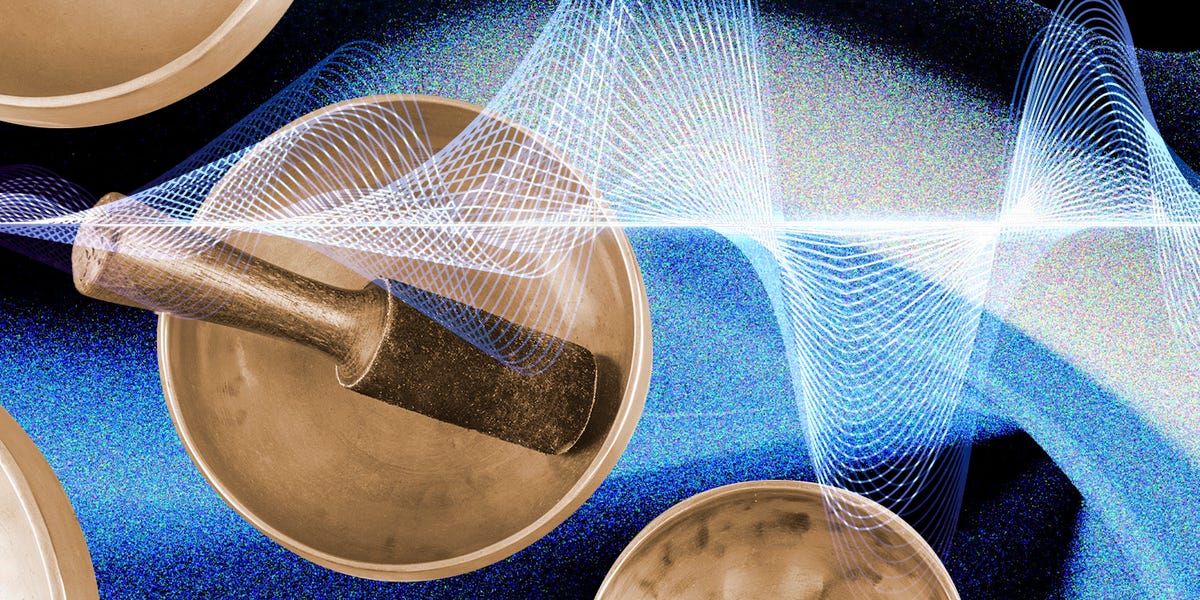
Sound baths trace their roots back to ancient meditative practices involving chanting, gongs, bells, and metal singing bowls, in which sound and vibration were thought to facilitate all kinds of physical and psychic healing. The modern version, though—the one colonizing wellness Instagram—is a much newer interpretation. The crystal bowls now synonymous with sound baths are largely a late-20th-century Western adaptation that exploded in popularity alongside yoga, “mindfulness,” and the broader realization that staring at screens all day might be making us insane.
The basic idea is that certain tones and vibrations can help coax the brain out of its default pinball-machine state and into slower-wave patterns associated with deep relaxation. Or, stripping out the wellness-industrial-complex language: You lie there while waves of sound wash over and through your body until your nervous system more or less gives up fighting. Proponents claim the sounds can lower cortisol, activate your parasympathetic nervous system, and interrupt the endless loop of screens, notifications, inflammation, performance anxiety, and whatever fresh psychic hell has just arrived via group chat. There’s actually some legitimate—if still fairly preliminary—science behind parts of that. Skeptics, meanwhile, would probably argue that being forced to lie still in silence and finally, briefly, unclench is doing most of the heavy lifting.
And unclench I did. It took about 30 seconds for the first waves to hit me, and after an initial external sensation that I would liken to standing next to a thumping subwoofer, I felt the vibrations pass right through me. The best way I can describe it is that it’s like being tickled and massaged from within, or maybe what it feels like when the ghosts fly through you at Hogwarts. (I’ve never been.) Either way, I remember smiling, and I remember thinking how good it all felt and how I’d never experienced anything quite like it before.
And then I remember waking up.
Wait, what? Somehow 40 minutes had passed. I had fallen quickly and steeply into a very deep sleep, and as I opened my eyes, the bath was just wrapping up. The panic set in: Did I drool? Snore? Subject this room of seemingly nice women who just wanted a little peace and quiet to a hideous nocturnal version of myself?
Turns out I didn’t really do—or miss—anything. My wife said my breathing turned heavier than usual but stopped just short of guttural. (She also informed me that she was so worried I would start snoring that she couldn’t fully relax herself, thus partially ruining the experience for her. Blame the bowls!) The good news, though, was that even after sleeping through most of the bath, I still felt different. The sound waves apparently still worked their magic on me even when I was passed out, and after the initial snoring-anxiety subsided, I left the room feeling looser and lighter—still tickled from within. And I get why so many otherwise rational adults are suddenly paying real money to be sonically waterboarded into relaxation. Sound baths exist in that very 2026 gray zone where neuroscience, placebo, ritual, luxury wellness, legitimate stress reduction, and low-grade woo-woo-ism all merge into one expensive nap you’re somehow supposed to call “somatic recalibration.” Believe me: There are worse ways to spend 45 minutes.


Richard Dorment is the editorial director of Men’s Health and Women’s Health.
Read the full article here