






EARLIER THIS YEAR, at the Australian Open, tennis superstar Jannik Sinner smashed ball after ball past an opponent on Margaret Court Arena. It looked so easy, as if he were playing a poor schmuck from the rec courts. The other guy was ranked No. 22 in the world.
I sat in the stands. Everyone looked a bit bored. Sinner looked bored, too, but he always carries a kind of focused-bored demeanor. Commentators like to talk about the violence of Sinner’s ball-striking, as if that were the main key to his world No. 2 ranking. They miss one of the real secrets of his performance: the way he’s achieved his near-constant state of chill.
He’s part of a growing cohort of elite athletes, including F1 master Charles Leclerc and skiing GOAT Mikaela Shiffrin, who are using brain training routines to achieve a state of engineered calm. They’re spending time at mental gyms that feature complex gadgets and data analysis, learning practices that build what’s known as mental economy. They teach their minds to spend less energy under stress so they can stay focused longer, maintain greater precision, tolerate pain better, and endure longer contests. These gains we all want flow beyond the stadium, too.
I also play competitive tennis, and I wanted a closer look at a mental gymnastics lab to see if I could pull some tools for my matches, my workouts, my lifts, and my life. Could I dial up my performance and somehow keep greater reserves in the process?
Working your brain waves
To engineer his winning chill, Sinner has spent hours strapping electrodes on his body in a lab under the guidance of Riccardo Ceccarelli, MD, an Italy-based sports physician with steel-gray, swept-back hair and a face lined by years of sun and studying numbers. For more than 30 years, he has obsessed over how the brain impacts athletic achievement. Dr. Ceccarelli founded a company called Formula Medicine to work with prominent race car drivers and now works with a cadre of tennis players as well. They include a few top 10s, he says, but outside of Sinner, he won’t disclose their names.
One of Dr. Ceccarelli’s mental gyms sits inside the stucco structures at the Piatti Tennis Center in Bordighera, in northern Italy. It looks like an F1 paddock had a baby with a gamer’s dorm room—datasets on an array of screens, Xbox controllers, padded chairs. Athletes strap biometric tracking devices on their heads and fingers, including a “brain band” that monitors their mind’s electrical activity, and the training/fun begins: video games, number drills, focus tests, visualizations, distraction modules, and more.
“If your brain is an engine, we want more horsepower and want to reduce fuel consumption,” Dr. Ceccarelli tells me. His psychologists watch the athletes and their live data as the challenges ramp up: In one car racing game, the vehicle goes faster only if you switch your brain waves to more focused patterns. Another game puts you in a distraction chamber full of the kind of noise and movement that a stadium contains, designed to pull your focus away from what you’re doing. All this helps the athlete and psychologist see where anxiety inflates exertion and stiffens muscles, fragments attention, and burns energy matches for no performance gain. That’s where your neural efficiency work needs to be done, and the lab helps you master the exercises that help you fine-tune it.
But what, exactly, are they training?
Our brains have roughly five frequency bands of electrical activity, or types of brain waves, happening at all times. How we perform in any environment—awake, asleep, training, competing, wherever—can depend on which brain wave type is firing most.
Mental gymnastics exercises help people automate the ability to move out of stress states (high-beta brain wavelengths) and into waves associated with precision, reduced muscle tension, and fluid execution (mid-alpha frequencies). Athletes training in this lab learn to recognize which moments and emotions spike brain strain for them, then work with their psychologist and run customized drills to return quickly to the neutral frequencies ideal for athletic performance. Sometimes all it takes is the pedestrian techniques all of us are tired of hearing about, like paced diaphragmatic breathing and self-talk mantras.
Human performance experts outside these labs say that the techniques have real credibility. “I’m generally a cautious scientist, but I’m pretty excited about the potential of both brain training and neurofeedback approaches,” says Greg Appelbaum, PhD, a psychiatry professor at the University of California San Diego who studies the brain and human performance. Studies have shown that consistently doing this kind of work can actually change your biology: The brain expends less glucose and oxygen for the same motor output.
There’s not yet empirical data on how much the benefits of this training wane if you stop or taper off, and Dr. Ceccarelli’s athletes travel with brain bands that allow them to be consistent with their brain training on the road. When I caught up with Sinner at a press conference at the Australian Open earlier this year and asked if he was doing his mental economy training, he nodded and said, “Ya, I have my at-home kit with me” and looked at me as if it were odd to think he wasn’t.

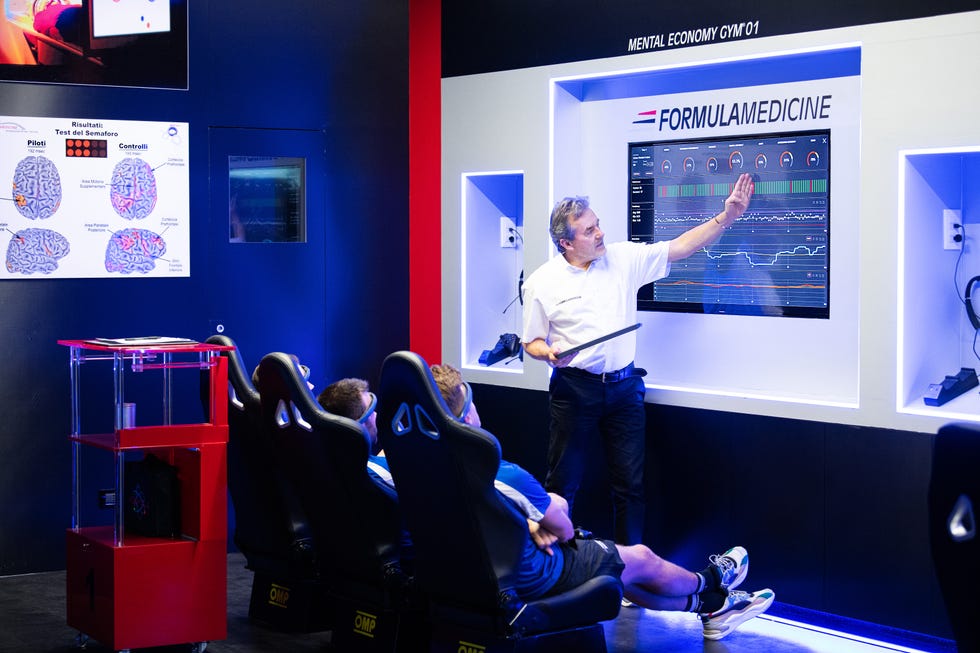
Dr. Ceccarelli reviews the data to show athletes where they can deliver more with less energy.
Engineering Calm
Dr. Ceccarelli prefers not to go into granular details of the data or the scales of gains by individual athletes with reporters. So after I talked with him, I checked in with a number of mental performance experts who have done similar work with athletes in soccer, sailing, skiing, and other sports. Then I set about experimenting with these mental economy techniques myself.
The first real step to achieving mental economy, the experts say, is noticing and naming your moments of physical and mental tension. Maybe it’s the moment your arms or legs feel tingly when you make a mistake or when you start getting tired; maybe it’s in the weight room when you step up to a bar with an intimidating number of plates on it.
We can all identify the moments when emotion, stress, and overthinking show up. To get back to neutral and encourage more alpha wave activity, there are dozens of tactics you can use. Sports psychologists and pro tennis players name more than I’ve ever heard of—breathwork, mantras, touching hot or warm objects, closing your eyes and moving them from side to side while counting, humming nostalgic tunes. The process requires a lot of situational experimentation.
It made me a bit obsessive, but I worked one by one through a long list of these options over about a month. Some worked well on one day and flopped the next. I leaned on tactile grounding most—in moments of overthinking, I’d focus on the texture of the felt on a tennis ball—and would proceed into the next point on a more even keel. I also felt my heart rate and a frenzied state of mind subside when I shut my eyes and shifted them horizontally while mentally counting backward from 95 to 90 before serving. I used the same modalities in my lifting, like when I approached a trap bar deadlift one-rep max with a coach, which I tend to view with heightened, stressed anticipation.
I found it easier and easier to identify the moment when my brain got busy. I flipped the switch to the mental exercises as opposed to following the spiral of overthinking.
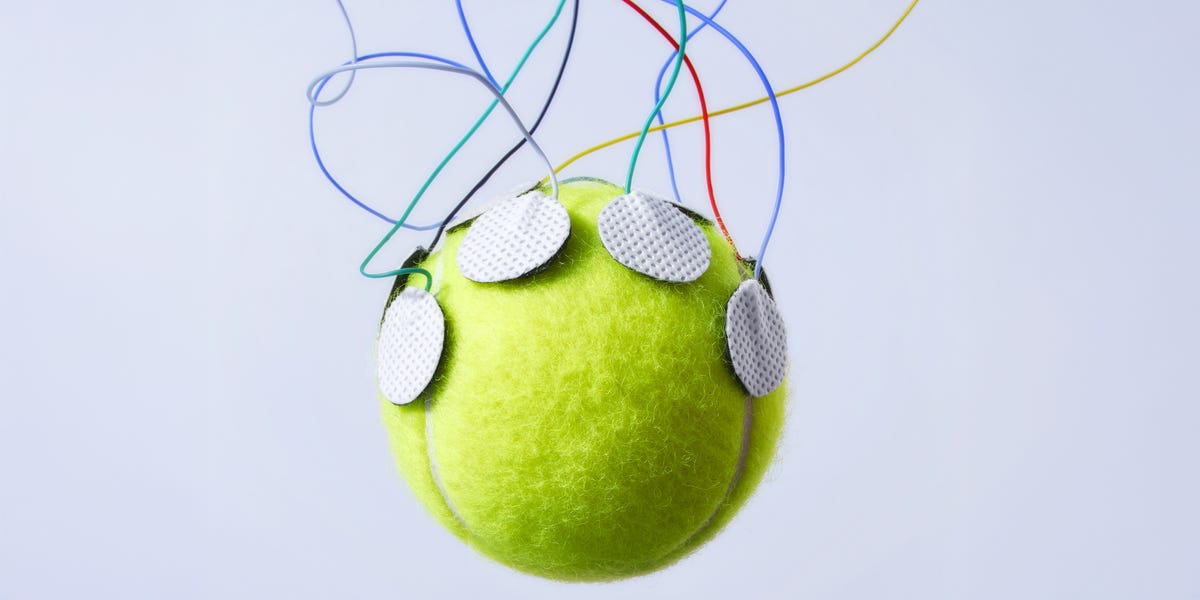
Eventually, though, I couldn’t help myself and got itchy for some data on just how well I was doing. So I got myself two popular (and not cheap) at-home brain monitoring devices—a Muse S Athena ($520) and a Sens.AI headset ($1,250). These track your brain waves and offer real-time biofeedback, teaching you where you can become more mentally efficient. As I used them, I went through guided meditations and simplified versions of games that elite athletes play. I intentionally stressed myself and then tried different techniques to calm down. I even put the band on during quiet breaks in tennis practice sessions. Over about three hours of play, I saw, via my brain waves, how amped I was and what worked to find more consistent neutrality.
The data is enticing. I’ll even say it’s awesome. But I found it helpful to also begin an analog practice (brain band or not) of writing down the moments when stress or overthinking began to creep in, even if gym buddies or hitting partners call you names for running over to your phone or notebook to make a note at random. It’s too easy to discount these moments otherwise.
My real triumph was in my steadied composure—call it newly engineered calm. Workout sessions came and went quietly with less internal static. Even the usual aches and strain on the tennis court felt much less urgent than usual. I left feeling more at ease and accepting of myself, too. The data was motivating, but it was really the iterative process of noticing that had me approaching Sinner-level boringness—which may be the most optimized state there is.


Nick Pachelli is a journalist, a producer, and the author of The Tennis Court.
Read the full article here


