



When social scientist and happiness expert Arthur C. Brooks, PhD, started teaching at Harvard in 2019, he expected to be energized by students asking big questions and seeking answers about what life might be about. It’s the stuff he remembered hashing out in his own college years. Instead of being filled with curious energy, he found students full of anxiety, depression, and disconnection—like they were living in a simulation.
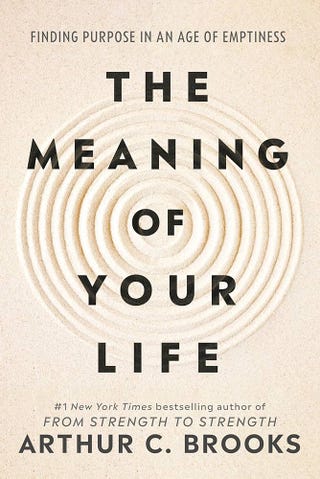
He started to see this full-on emptiness epidemic far outside campus borders. His investigation into what was missing and how to find your way to fulfillment turned into his new book, The Meaning of Your Life. Which is a lot less woo-woo than it sounds when he explains the science behind how our habits hijack our brains and rob us of our ability to seek and find purpose. On the eve of the book’s publication, we asked him more about why so many of us are in this empty spot, and why it’s worth doing a little work to dig out.
MH: Meaning seems to be having a moment. Yours isn’t the only book on it that’s come out recently. Why do you think there’s this interest in meaning now?
AB: Part of the reason is that even with all of the upsurge and interest and wellness, one of the things that’s been missing is the sense of purpose in life.
Reason number one is that all this culture of wellness is not getting the job done. People are finding that that just living your protocols and living your best life and going to the gym and working hard and going to Harvard and getting a job just isn’t enough.
Number two is that people are starting to figure out that something has gone wrong with their brains in the age of technology, and they want to solve that.
Now this book is different than the other books on meaning, because the other books tend not to be very scientific, and this is really a book about why your brain craves meaning and how to give your brain what it actually needs. So in a way, it’s like the “bro protocol for meaning” book.
MH: You mention that people feel like they’re living in a simulation, not a real life. How do you get from where you are now to a place that feels like there’s purpose and meaning in your life?
AB: The question of What is meaning? is really, really big. That’s why I talk about how meaning involves the answers to these big “why” questions: Why are things happening the way they do? Why am I doing what I’m doing? Why does my life matter?
Then the question is, where are the answers to be found to those big why questions? And the answer is not Rome or the beach or necessarily even church. It’s the right side of your brain. The right side of your brain is the part that we use to answer big “why” questions of meaning. The left side of the brain is the side we use to answer, “how to” and “what” questions—the technical stuff in life, like how do I build an app that finds a pizza at 10pm or how do I find the simplest way to get to Chicago on Saturday?
The problem is that modern life has pushed us away from the right hemisphere of our brains. The more time you spend online, the more time you spend in the hustle and grind culture, the more that you’re actually losing your ability to exercise the big, mysterious meaning filled right hemisphere of your brain, and that’s the reason that you don’t know the meaning of your life.
MH: It’s a lot easier for me to just look at my phone instead of asking these questions. That’s tough.
AB: Yeah, I know. And back in the old days, of course, those questions came, whether you wanted them to or not. You know, when I when I was 18 years old. I spent one year in college. I had one unsuccessful year in college in my first run, then I went to college 10 years later, and it was successful. But in my first unsuccessful run of college, what did we do at 11 o’clock at night after drinking beer and hanging out? We had pretentious, big conversations.
Now, people do this [looks at phone]. That’s a problem. The reason we would ask big questions is because that’s what your brain naturally does when you have nothing else to do. That’s a boredom problem. What we’ve done with devices is that we’ve solved the boredom problem. Boredom is extremely uncomfortable, but boredom is absolutely necessary for your brain to work the way it’s supposed to work.
It’s actually engaging a series of structures called the default mode network inside your brain that sends you right over to the right hemisphere and makes you think about the meaning of life. The irony is that people have figured out a way to make sure that no single moment is boring, but their lives are unbelievably boring.
MH: So how can you open the door to more conversation between your right and left brain hemispheres?
AB: The way that we do that is by actually living in a different way. We’ve got to detox. For one thing, people are neurochemically addicted to their devices. So there’s a whole chapter in this book about how to get de-addicted without throwing your phone away.
MH: It reminds me of how quit-smoking programs advise people to not just quit, but find something else to do when they want to smoke.
AB: That’s true, although, it’s more like managing your diet than it is like quitting smoking. You’re not going to go to zero in your diet. You need to learn how to manage.
And the way that you learn to manage is that you have more important things to do than you would have done with your phone under the circumstances. One of the best predictors of addiction relapse is not having anything to do instead. There are people who are always at risk of relapse because they didn’t address the underlying need that they had. The underlying need—they were anxious, or they were bored or they were lonely—is why they were drinking in the first place, and that’s what you actually have to address.
The truth of the matter is that if you don’t understand yourself and you’re using your phone to distract yourself from mental anguish, you don’t do anything about your underlying needs. And so that’s why a lot of this book is an explanation of how important it is to be bored and to lean into that boredom in a very productive way.
MH: That boredom is really uncomfortable. How do you deal with that discomfort?
AB: Part of what I do with my boredom is be conscious of it. A lot of what I do is I pray instead of using my phone. On the plane when they make me put away my laptop, that’s when I pray. I’m going to say my prayers every day anyway, so I use that time to do something that’s going to be illuminating the right hemisphere of my brain and be a transcendent activity, as opposed to pushing me into the left side simply to crowd out my boredom.
MH: So suppose you do ask yourself all those hard questions about why your life matters. What if you think your answers aren’t good enough; that they sound kind of dumb?
AB: The answer is that it doesn’t matter. What will actually lead you to the meaning of life is not your answers, but the work of asking the questions.
MH: What’s the main question you get from your students about your approach to finding meaning?
AB:“When will I have solved this problem once and for all?” And the answer is, never. This is a lifelong search. The real question to ask is, what do I need to do to start making progress? And most people haven’t started and aren’t starting, and that’s the real problem.
So the right question is not, “when will I know absolutely the meaning of my life?” The question is, “When will I be making progress toward the meaning of my life?”
MH: But isn’t it so much easier to stay in one’s simulation?
AB: That’s the problem. The simulation is comfortable, which is exactly the plot of The Matrix. It’s built to keep us placid and keep us comfortable and to shut up and to keep consuming.
The only reason to go out of it into an uncomfortable world is if somebody gives you a really, really good reason, and this book is the reason. In the simulation, you’re not going to find the meaning of your life, and you’re going to be depressed and anxious and lonely. You can feel empty for the rest of your life, or you can break out into the world of discomfort and say, Bring it on. And the reward for you will be the meaning of your life.

Marty Munson, currently the health director of Men’s Health, has been a health editor at properties including Marie Claire, Prevention, Shape and RealAge. She’s also certified as a swim and triathlon coach.
Read the full article here