





YOU’RE 28 YEARS OLD, and you’re lying in a hospital bed, more dead than alive.
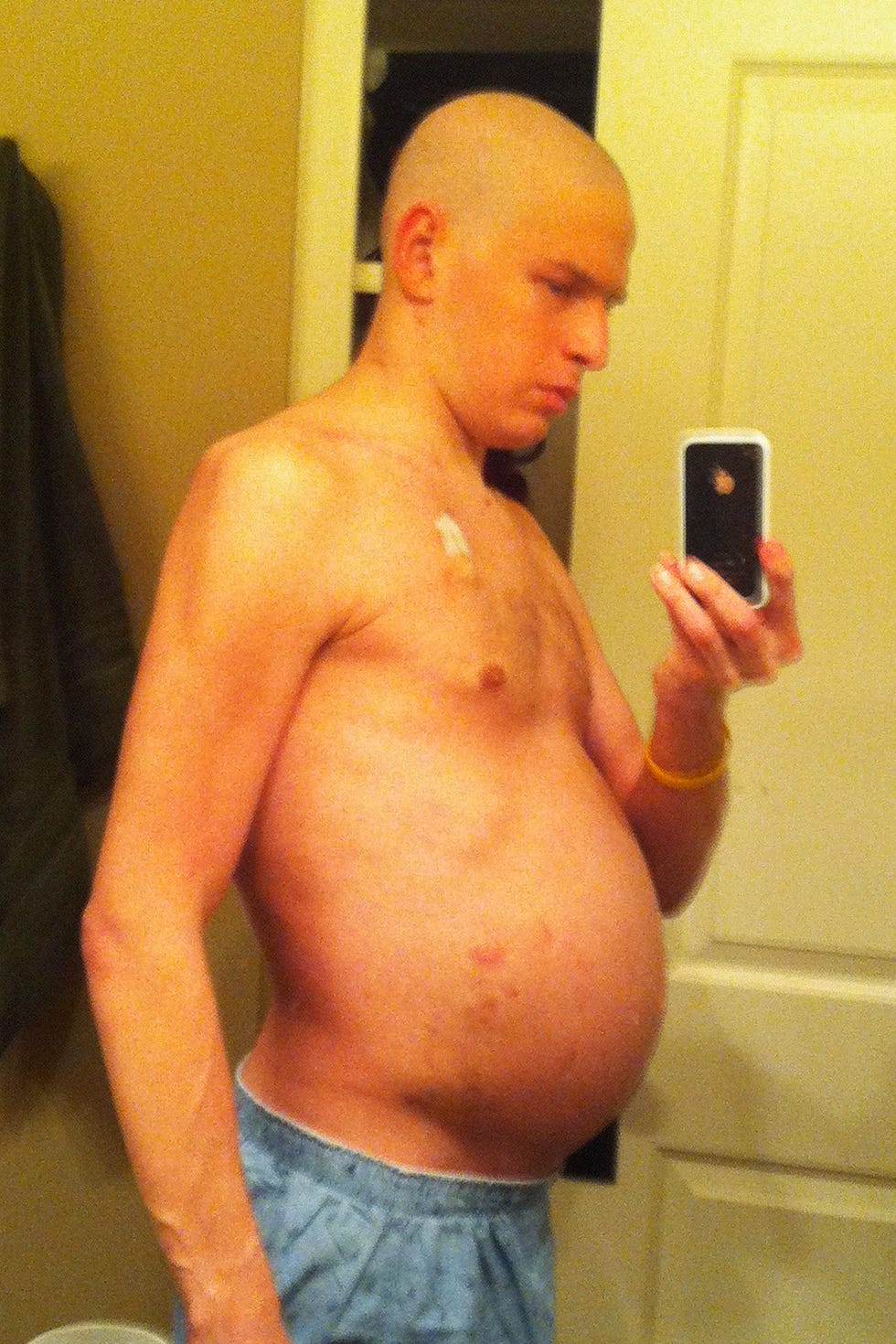
Your organs are failing. Your kidneys have stopped functioning, which means you can’t pee, so fluid is collecting in parts of your body where it shouldn’t. The nurses drain it from your belly a few times a week, liters at a time, but there is always more. Your stomach, once hardened from hours in the gym and tanned from hours on the field, is a pale monstrosity several watermelons big. Your legs are waterlogged.
Your liver, too, is failing, and toxins are building up in your blood, so much that your cognition is fading. You can’t think straight, and you’re not sure you understand what’s happening to you, but you know it’s very bad.
Your body temperature is so high that your sisters and the nurses are packing ice all around you on the bed. You feel nauseous all the time, like you might vomit at any moment, and sometimes you do. You can’t walk anymore.
The second time this happened, three years ago, a priest came into the hospital room and read you your last rites. Your friends came, some even flew in, to say goodbye. Your father, your sisters—they said goodbye too, just as you had all said goodbye to your mother. As people filed into and out of your room, it was like grieving every person close to you all at the same time. They were saying goodbye only to you, but you were saying goodbye to everyone.
She died, your sweet mother. The brain tumor was too much and too big and too fast. But this thing, this disease you have…they barely know what it is. No one has this thing, or almost no one. And this is now the fifth time it’s happened, the fifth time it has savagely attacked your organs and your hope and your life.
The priest doesn’t come anymore. Only your dad and your sisters are there. But always your dad.
You’re going to die. It’s not just the look in the doctor’s eyes that tells you this. He has actually said it to you: You’re out of options. You’re going to die. There’s no more medicine for you, nothing else to try. Too few people have this disease for it to be widely studied, and there’s not enough profit for the pharmaceutical companies to make from investing in a new drug for it. And the drugs the doctors have tried on you already, a combination of seven different chemotherapy drugs, were desperate, off-label tries—they weren’t even designed to treat this thing you have. Somehow they’ve beaten it back so far, but they aren’t working any longer.
As you lie there in your delirium and heartbreak, a human waterbed, a thought burrows into your half-capacity brain like a weevil. Maybe it’s an absurd thought, you can’t tell. But…those seven drugs…they kind of worked. They did something. They put the thing into remission four times. It always came back, but…maybe there’s an eighth drug? What if there’s an eighth?
But your doctor is the leading expert on this thing in the whole world. One of the only experts. If he doesn’t know about another drug, there’s not another drug.
But what if there’s another drug?
But they told you you’re going to die.
But you don’t want to die.
What do you do? What does a person do in this situation? Are you going to die?


HE WAS A YOUNG GOD.
He played D-I football at Georgetown. He was the quarterback, of course, with shoulders like two-by-fours, floppy brown hair and a little-boy smile, and a cross around his neck. He had one of those long names that stretched all the way across the back of his uniform: FAJGENBAUM. Fay-gen-baum. In a scrimmage before the season started, the freshman threw for five touchdowns and no interceptions.
For a while there, it was good to be David Fajgenbaum.
Then they found cancer in his mother’s brain. Right away David asked his coach if he could be taken off the travel squad and play only in home games; on away-game weekends he traveled back to North Carolina to see his mom. He wanted to believe that on those weekend trips home, he was helping her to get better, not that he was cramming in as much time as he could with her before she was gone.
A little over a year later, in October 2004, Anne Marie Fajgenbaum died. David was 19. This was by far the worst thing that had happened in his life. In grieving his mother’s death he discovered what kind of person he was, in that way grief has of squeezing us tighter and tighter until our true selves emerge, like a rush of clear water. David’s true self? He already knew something about it, from playing sports. He knew that losses motivated him more than wins. He knew that when games went into overtime, he felt stronger than when his team was up by 50, because the fear of losing a game as time ran out awakened in him not only power and precision but resourcefulness and creativity.


David training for Georgetown football in July 2005.

After losing his mother he felt all this—but felt it even more, as if the volume were turned up.
He began working out longer in the gym and working harder at school. He switched his career path from orthopedics—and sports medicine specifically—to oncology research, having sworn to his mother before she died that he would devote himself to finding cures for cancers like hers. “I wanted revenge,” he would later write. He understood that the college years are already a weird time of maturation, confusion, fear, and growth, making them a particularly bad time to endure the death of a loved one, so he started a support group at Georgetown for students who had suffered losses. He called it AMF, using his mother’s initials. Only now he decided AMF stood for Actively Moving Forward.
Senior year he met a girl at a bar, and he allowed himself to open up to her in ways he never had before. Her name was Caitlin, and he thought he might marry her one day.
David kept propelling himself forward. He graduated from Georgetown and completed a two-year master’s program in cancer research at Oxford in only eight months. He started medical school in 2008 at the University of Pennsylvania on a full scholarship. During med school he was also running AMF, which now had chapters at dozens of schools across the country. Caitlin, who was a couple years younger, had started a chapter at Meredith College in Raleigh, North Carolina, where she was still in school.
It took some work, but it was good to be David Fajgenbaum again—until Caitlin broke up with him. They had been dating for three years now, but she felt he was just extending himself in so many directions. Plus, they were seven hours away from each other. The breakup was devastating, but to David it didn’t feel final. It didn’t feel like this was how it was going to be.
He worked out even harder and longer in the gym, pushing himself to exhaustion. He was even bigger and stronger now than he had been as a D-I quarterback—his friends started calling him the Beast. (One weekend he and some friends drove to Virginia for a bench press competition. David benched 375 pounds and won.) He worked longer hours in the hospital and on his studies. Caitlin started talking about getting back together.
And then one day in July 2010, David was taking a shower and he noticed that the lymph nodes in his groin were swollen.

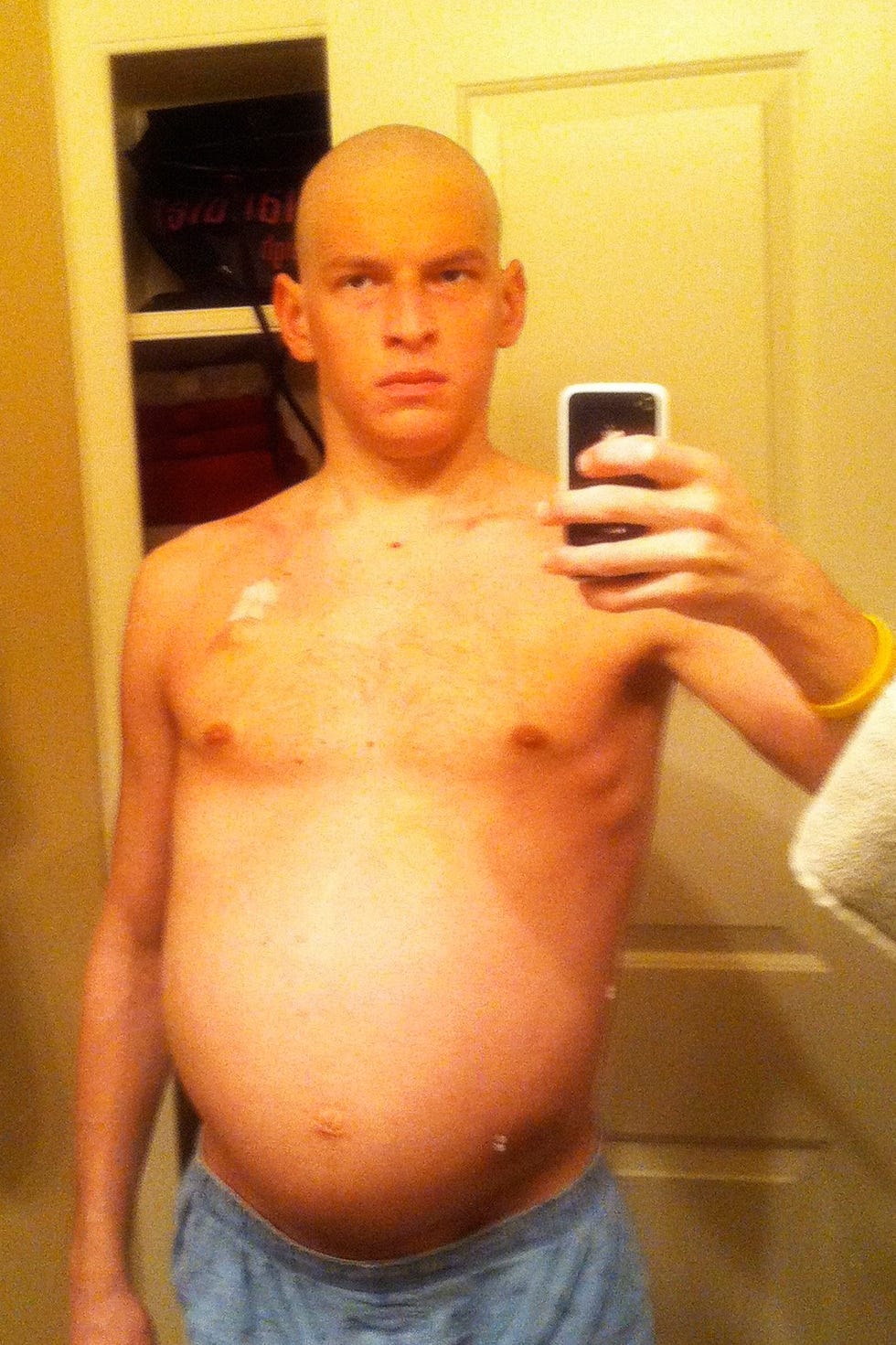
David after he was discharged from his first extended hospital stay in the spring of 2011.


SOME MEDICAL SCHOOL students suffer from what is loosely called medical student syndrome: The more they learn about all the ways a person can get sick or die, the more they start thinking they see all kinds of symptoms in themselves. It’s a sort of educated hypochondria.
Two years into med school, David wanted no part of that, and over the next few weeks he rationalized a worsening constellation of symptoms, figuring he was just overworked and they would go away. The lymph nodes in his neck were now engorged. He could sleep for 12 hours and still feel tired. He had trouble summoning the energy to work out, which had never happened before. Small blood-colored moles appeared on his arms and chest. Night sweats. Stomach pain like you wouldn’t believe. Finally, after taking an exam one day in which he could barely understand the questions, he stumbled into one of the same emergency rooms he had trained in. He barely made it to a bed before nurses were drawing his blood, a doctor ordered a CT scan, and a report showed that every lymph node in his body was badly swollen. Even as a second-year med student, David knew what they were going to say: lymphoma.
Except that it wasn’t, or upon further testing didn’t appear to be. What was certain was that all of his organs were shutting down, a condition called multiple system organ failure, also known as you’re fucked. His body was not working. He couldn’t move his body for weeks. The doctors gave him smothering doses of corticosteroids, which is what doctors sometimes give when they don’t know what else to give.
In the hospital the priest came and read him his last rites. His friends flew in. His sisters hugged him and cried. His father slept on the pull-out chair next to his bed every night.
Then, with a suddenness that was just as confounding as the onset, he got better. For no reason that any doctor could explain. He was discharged from the hospital. He peed out gallons of fluid and started to look kind of normal again.
And then, four weeks later, he couldn’t get out of bed again.

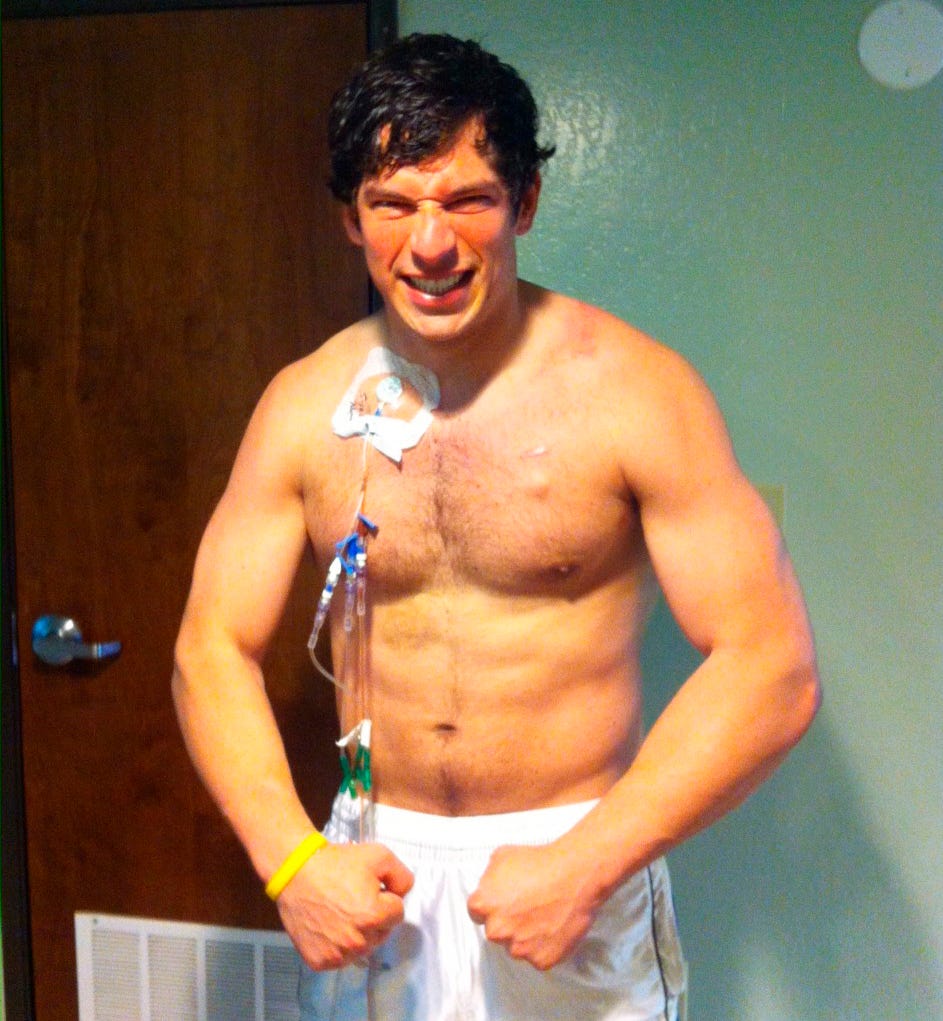
In May 2012, David ended up back in the hospital after another relapse, but his spirits were high.

THE NAME OF the disease sounds triumphant. Regal, even. Castleman, it’s called, after the doctor who in 1954 discovered strange patterns in lymph node secretions in about 10 patients—Castleman disease, they named this nebulous thing. Today, about 5,000 people a year are diagnosed with Castleman disease, around the same number as ALS. David’s subtype was called idiopathic (meaning: we don’t know what causes it) multicentric (meaning: there are multiple epicenters all over your body) Castleman disease, or iMCD. When you have this type, your lymph nodes secrete too much IL-6, which is a cytokine—cytokines being immune-cell secretions that pretty much run your immune system and keep you healthy. So, yes, IL-6 is a good thing—except when your body freaks out (because you have iMCD) and starts producing oceans of it, and you die.
David had relapsed. Again, his body filled with fluid—at one point nurses were draining six to seven liters from his abdomen several times a week. Again, his organs failed, he vomited, he felt debilitating abdominal pain, the blood moles appeared, his legs blew up, he couldn’t move.
They decided the steroids weren’t working and settled on a heavy course of a chemotherapy drug. And the damn thing went away again—and after another mysterious reprieve of a few weeks, it came back. This disease came and went for about three years, torturing him like a stray dog circling a rat, shaking it in his fangs every so often for fun.
During this third relapse of iMCD, the FDA and the drug manufacturer granted David emergency compassionate use of a new medication called siltuximab, which had been shown to block the release of IL-6. That, together with the seven-chemo-drug combo—“carpet-bombing,” David called it—worked until it didn’t, and David knew his body couldn’t take much more chemo. There is a finite amount of chemotherapy anyone’s body can absorb in its lifetime before the drugs become deadly, and David was reaching that limit.
Every time David was in the hospital, his father, an orthopedic surgeon in North Carolina who is also named David, essentially shut down his practice for months at a time so he could be at his son’s bedside. He lived out of a duffel bag and showered in the bathroom they had for families. One night, he was standing in the hospital cafeteria staring at the dinner buffet. He doesn’t know how long he was standing there before he noticed the man in the hairnet who was serving food asking him if he was okay. The front of his day-old T-shirt was wet with tears. From then on, David’s dad drank two Ensure nutritional shakes out of the patient fridge on David’s hall every night for dinner.

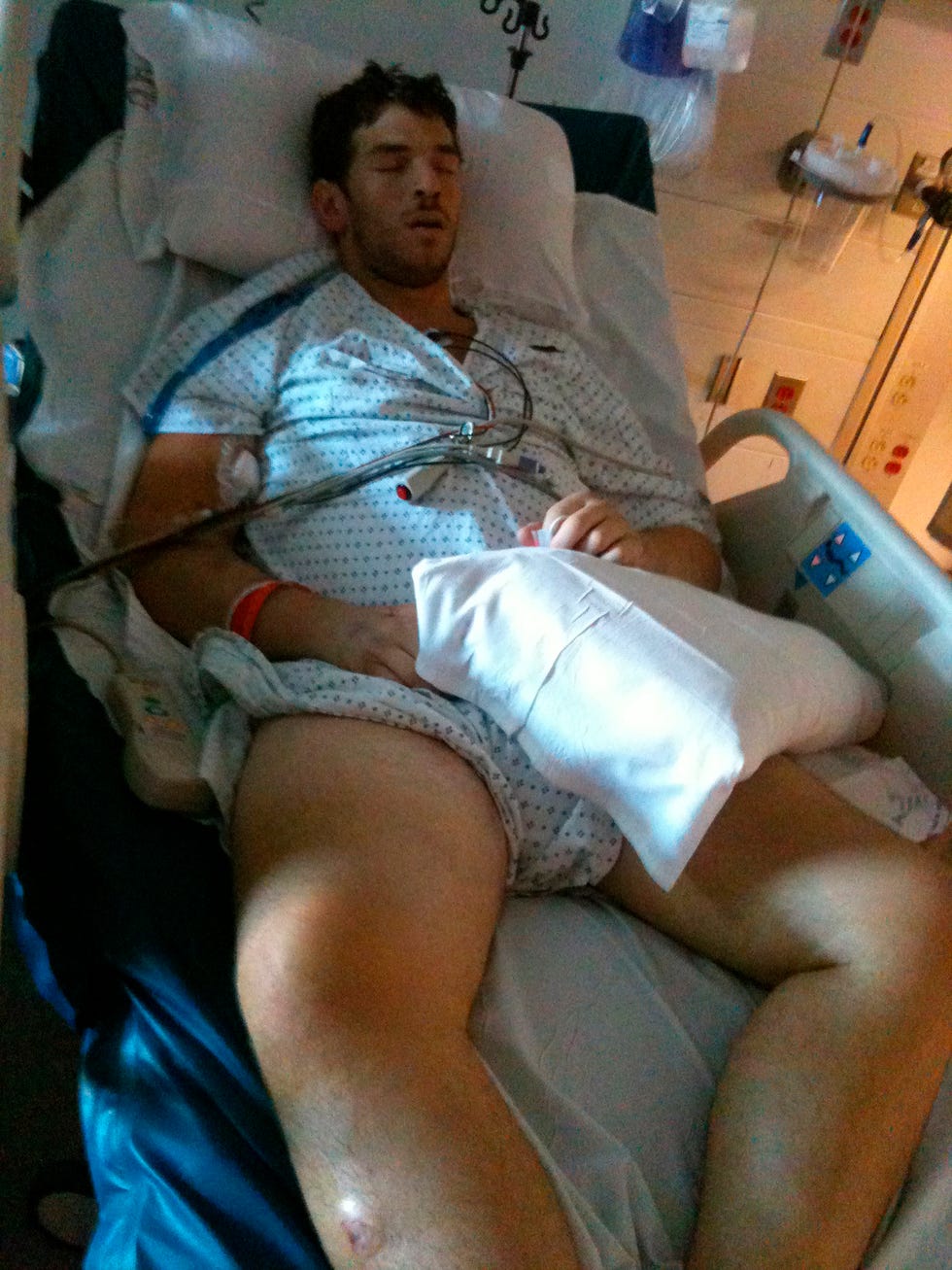
David in 2010 during his first relapse.
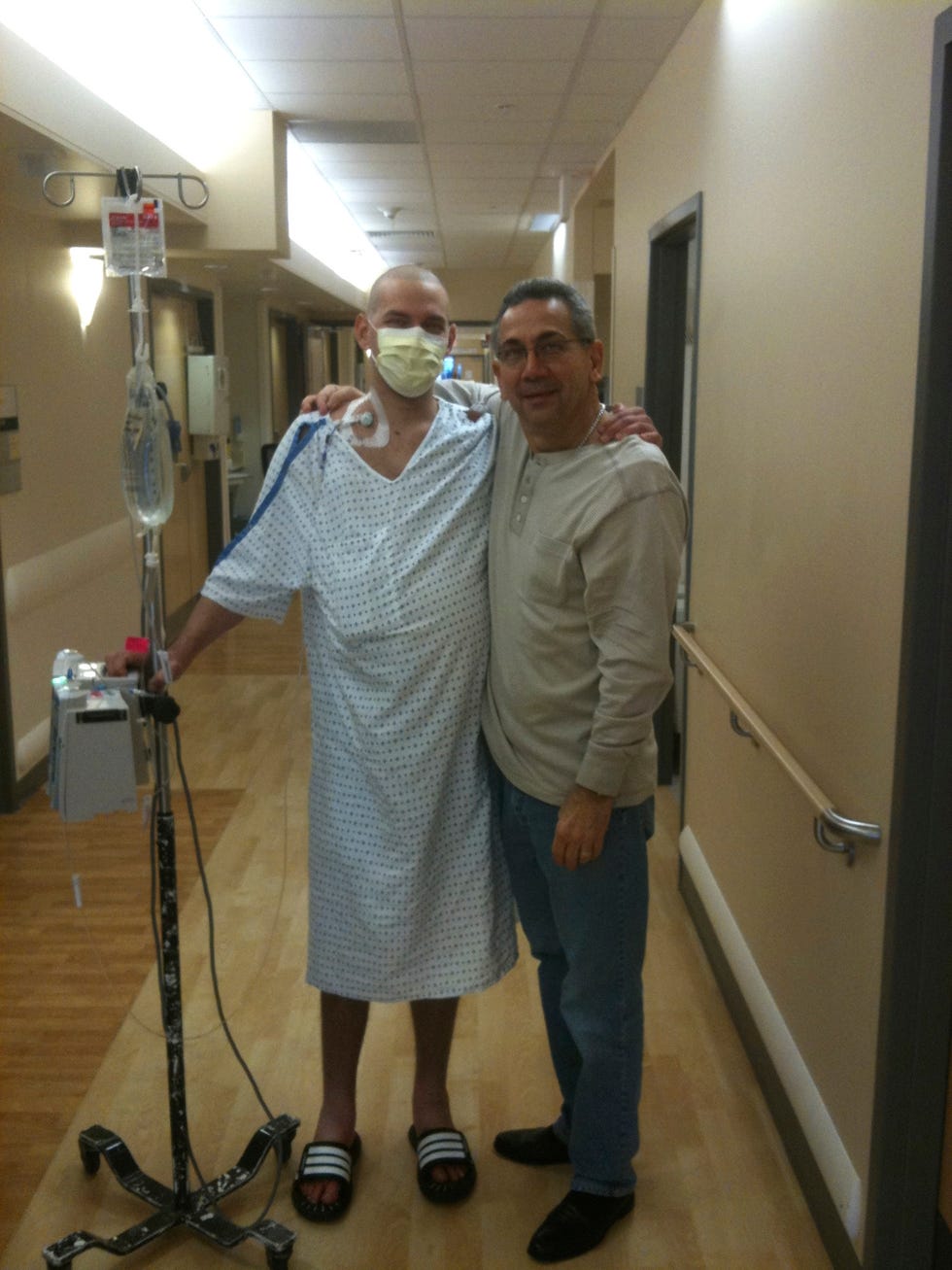
David became sick again in the middle of medical school in 2011. His dad (right) stayed by his side throughout all of his relapses.
Each blessed break between the relapses felt like another overtime, a perfect cliché if there ever was one. In his mind, David’s only option was to win. He finished medical school. He cofounded a Castleman research society, the Castleman Disease Collaborative Network (CDCN), which took on the mission of finding everyone in the world who might know anything about Castleman—doctors, patients, researchers, pharmaceutical companies, friends of friends who knew someone who might have had it. Anyone. As far as David could tell, the CDCN was the first of its kind: a nonprofit devoted to a single disease that didn’t rely on people finding it but rather it finding people. Instead of offering grants and hoping the right doctors applied for them, it scoured the planet for the right people and then connected them with other people, and then other people, until every scrap of information about Castleman was known to everyone else in the community. It was like a rudimentary AI chatbot, except it was made up of humans and only answered questions about one thing: Castleman disease.
After med school at Penn, David started business school at Wharton. He figured that if the CDCN was going to succeed—if it was going to save his life, and then many other lives—he needed to know how to run it.
Because for all his energy and smarts, the relapses persisted. The expert he had found, Frits van Rhee, MD, PhD, at the University of Arkansas for Medical Sciences, was the Castleman guy in the world. They had worked together during these relapses, studying thousands of pages of papers and studies, searching for irregular connections and patterns between immune-cell types and cellular communication that might have caused David’s disease. They found almost nothing helpful. Yes, Dr. van Rhee did secure siltuximab when David was too sick to be in the trial, and he did conjure the cocktail of chemo drugs that had so far staved off death, but the whole effort felt like trying to cover a volcano with tinfoil. The thing kept coming back. If Dr. van Rhee didn’t know of a drug, there was no drug.
David revered doctors. By this time, he was a doctor. And yet a strange, hard fact was coming into focus for him: Without a drug to prescribe, there is only so much a doctor can do. Sure, a doctor has to be great at diagnosing diseases and deciding how to administer drugs, but without a drug to prescribe, what good is that diagnosis? What does it tell you, other than what atrocities and pain are about to befall you, which no doctor can stop?

BY THE THIRD RELAPSE, David was starting to see that there are two kinds of hope.
There is passive hope—that’s the most common type. We feel it for all kinds of things, things we want to happen and things we don’t want to happen.
I hope the Steelers win.
I hope I get this job.
I hope it doesn’t rain.
I hope it isn’t broken.
I hope they’re right.
I hope she says yes.
I hope it’s benign.
I hope my mom doesn’t die.
Passive hope is usually about things we either can’t control or can only control so much. It’s the kind of hope we feel when we are patients. We hope the doctors know what they’re doing, and we hope the course of treatment they suggest works, because if it doesn’t—
But here was David Fajgenbaum, who was both a patient and a doctor, which is nothing new, except that he was a patient and a doctor who had been told there was nothing else a doctor could do. In these rare situations doctors become detectives, but there were Castleman detectives around the world, and the clues were not adding up to anything that would save David’s life.
When he relapsed the fourth time, in December 2013, David had discovered the second kind of hope: active hope. The kind of hope that makes you take control of the plane instead of hoping it doesn’t crash. He had to work harder, think harder—and faster.
Because enlarged lymph nodes were the most common first symptom of Castleman, it had—since Dr. Castleman’s research in 1954—been considered a disease caused by enlarged lymph nodes. All iMCD patients have enlarged lymph nodes, so they must be the culprit! “But,” David would later write in his gripping memoir, Chasing My Cure, “that’s like saying that firefighters must cause all fires because you always find firefighters near fires.” What if the overproduction of IL-6 was really the result of a hyperactive immune system? What if, instead of using drugs that inhibit IL-6, they tried drugs that slow the immune system, like the medicines people take after receiving organ transplants? Immunosuppressants, they’re called. When someone gets, say, a new liver or kidney, immunosuppressants make sure the immune system doesn’t attack the new organ as if it were a foreign invader.
It was off-label—way off-label—but…what if?
This created an interesting situation: David was very sick. This was his fifth bout with Castleman overall. No one had thought there would even be a second. Not a lot of games go to five overtimes. But the kind-of good thing about his being sick was that he would know quickly whether a drug was working. Of course if one immunosuppressant didn’t work, he would have even less time to try another one.
David was feeling it now. He was seeing the field. His dad remembers that back in kindergarten, one teacher said that David had such difficulty paying attention and learning that he might need to be held back. Now here he was focused and learning at triple speed.
The first immunosuppressant didn’t work. Cyclosporine was the one they tried, and it failed.
David again began studying many years’ worth of his own blood work results, the journal articles and studies, the thousands of bits of information collected through the CDCN. They didn’t have time to cycle through too many more immunosuppressants, hoping one worked. What was he missing?
In the end, it seemed so simple. It wasn’t, but the pattern of signs emerged, first in bas-relief and then more clearly. For most of his life since he was a teenager and into his illness, doctors performing routine checkups on David had remarked on the number of blood vessels he had. An ophthalmologist in high school, an endocrinologist in his 20s, a hematologist: Huh, they all said. You have a lot of blood vessels! And they moved on. But David wondered if his abundance of blood vessels was connected to the increase in a particular protein that always seemed to occur with his relapses, an increase that hadn’t seemed consequential to him, to Dr. van Rhee, or to any of the other brilliant, incredible doctors who had treated him or with whom he had consulted. And what was the one symptom present every time just before a relapse? Those damn blood moles on his chest.
As every high school biology student knows, cells communicate with each other to regulate all kinds of processes within the body. David found a line of cellular communication that stimulates the production of the protein in question. What if there was a drug to shut down that line of communication—to get these cells to stop telling those cells to make this protein?
He frantically searched databases of clinical trials and FDA approvals and found an off-patent medication that had been approved to do exactly what he thought—hoped—he needed it to do.
There was another drug.

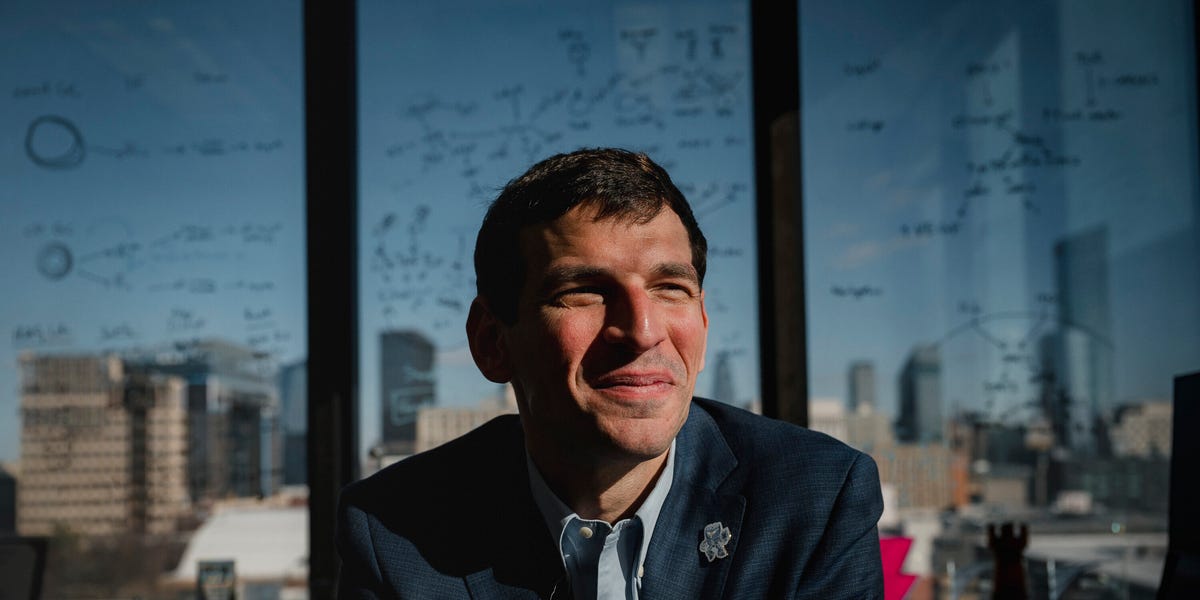
“NO DAY IS typical, but I’ve got two little kids—a 7-year-old and a 4-year-old—and they usually wake me up pretty early,” David, now 40, says. He smiles, the little-boy smile under the floppy brown hair, his head framed by the Philadelphia skyline out his office windows. On the glass are written diagrams of protein chains and cellular relationships and equations in black marker—he often runs out of whiteboard space and just starts writing on the windows.
“That’s partly because oftentimes they come to our bed in the middle of the night and sleep.”
This is impossible, that David Fajgenbaum is sitting in this office with the cold afternoon sun bouncing off his desk, talking about his children. His children! He married Caitlin, the girl from the bar who kept coming back and who loved him and wanted to wear his ring and married him before all his hair had even grown back from the last round of chemo.
The drug is called sirolimus. It had been around for 25 years and was typically used to treat patients who had received kidney transplants. It worked. It’s working. He takes three milligrams every day. It’s been 12 years with no relapses.

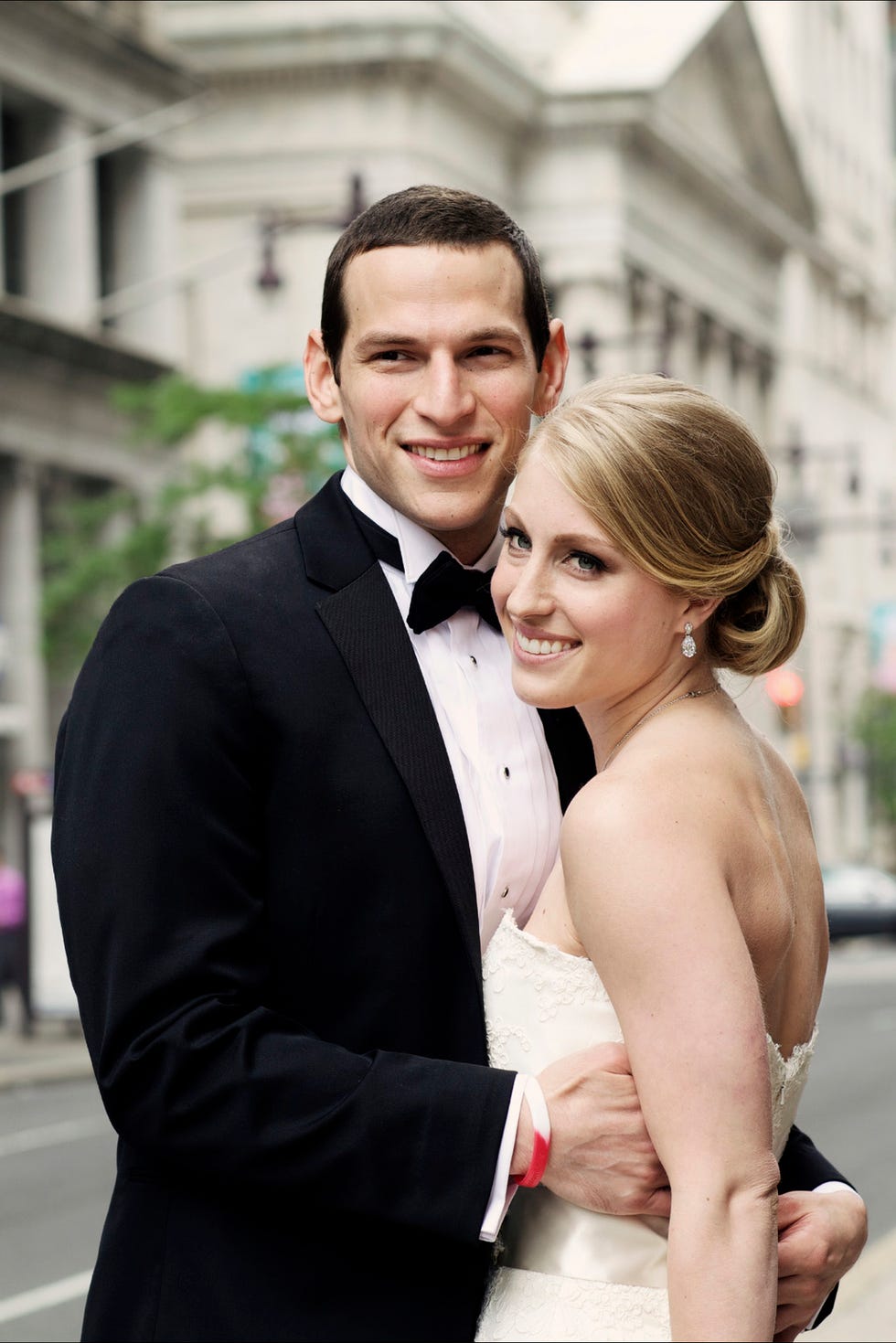
David with his wife, Caitlin, and their daughter, Amelia.
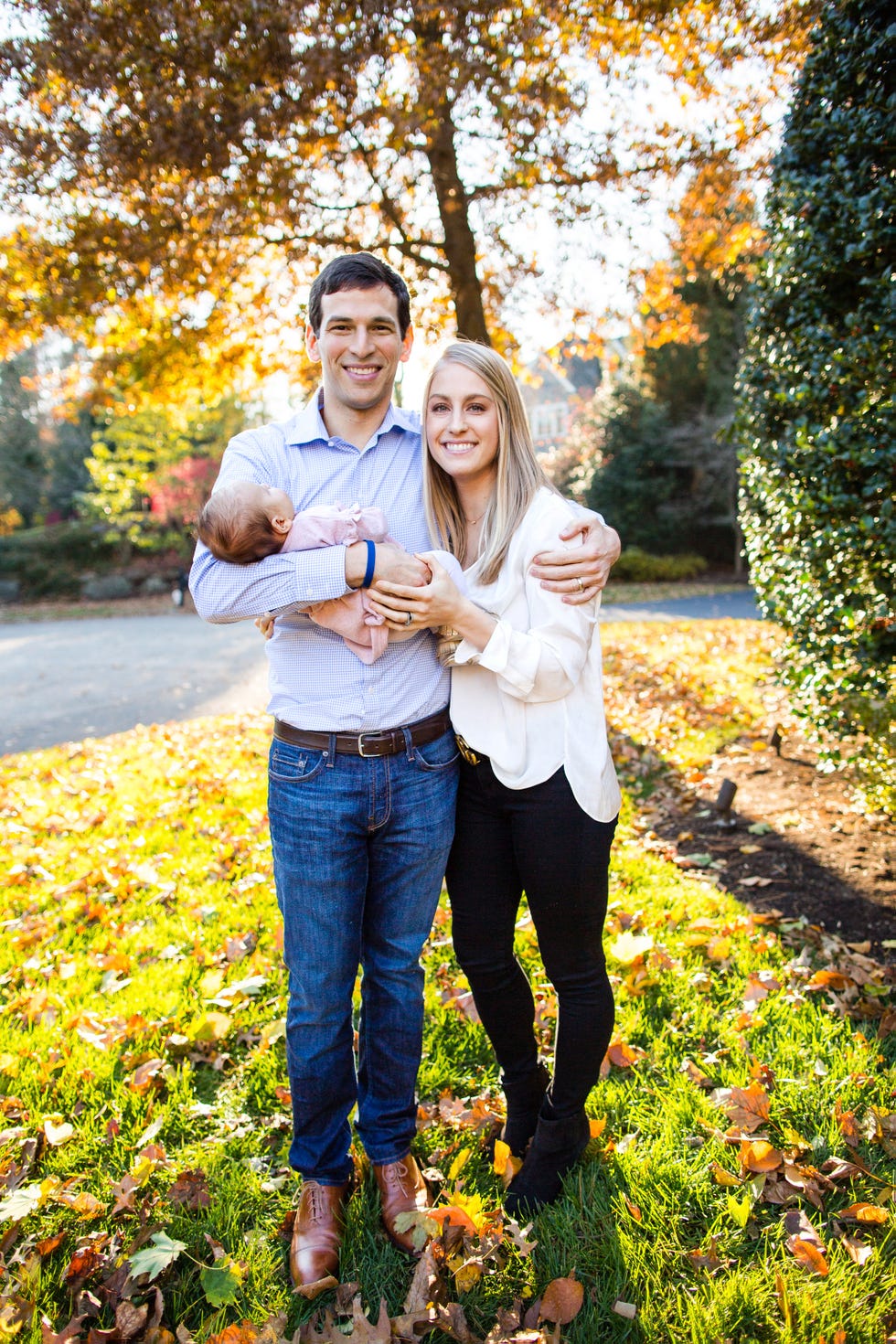
They tried it with other iMCD patients. It worked in the one after David, and the next one after that. They thought they had it. The fourth patient died. And David knew what he could do. The whole journey, every desperate Google search, every carpet bomb, every email to a doctor in Japan or England or Arkansas, every all-night rabbit hole—all of it had been a blueprint, a way to find alternate uses for existing medications to treat rare diseases. There were lots of diseases like Castleman: infecting hundreds or even thousands of people each year, but not enough to attract the amount of money it takes to find remission or a cure. But David had found a weird immunosuppressant that worked on his Castleman—it was sitting right there on the shelf at CVS all those months and years; every time his sisters said goodbye for what felt like the last time, there it was. That makes it sound easier than it was to find, of course—it was a needle in a thousand haystacks that no one would have ever thought to look for.
But surely there were other medicines for other diseases.
Just as he had started AMF, just as he had started CDCN, in 2022 he used that blueprint to launch Every Cure, a nonprofit research lab devoted to finding new uses for existing medications. There are 4,000 FDA-approved drugs in the world today, and about 18,000 diseases. If you were to try every drug on every disease, you would have to try 75 million different possibilities. Every Cure developed an AI platform that gathers every crumb of data about every disease and every medication and sifts all of it looking for matches. Using that data, it can spit out a score between 0 and 1 indicating how likely each connection is to being a perfect match—one of the 75 million.
The organization is different from other drug-repurposing companies in chief because it’s a nonprofit, and also because it’s what David calls “all vs. all”: It doesn’t begin by focusing on finding a drug for a specific disease or a disease for a specific drug. It begins by looking across all drugs and all diseases to find the very best opportunities to help people, regardless of the disease, the drug, or the profitability of the opportunity. It works end-to-end, first identifying the most promising repurposing opportunities, then doing the work to prove they’re effective, and finally taking the responsibility to make sure the drugs reach doctors who can prescribe them.

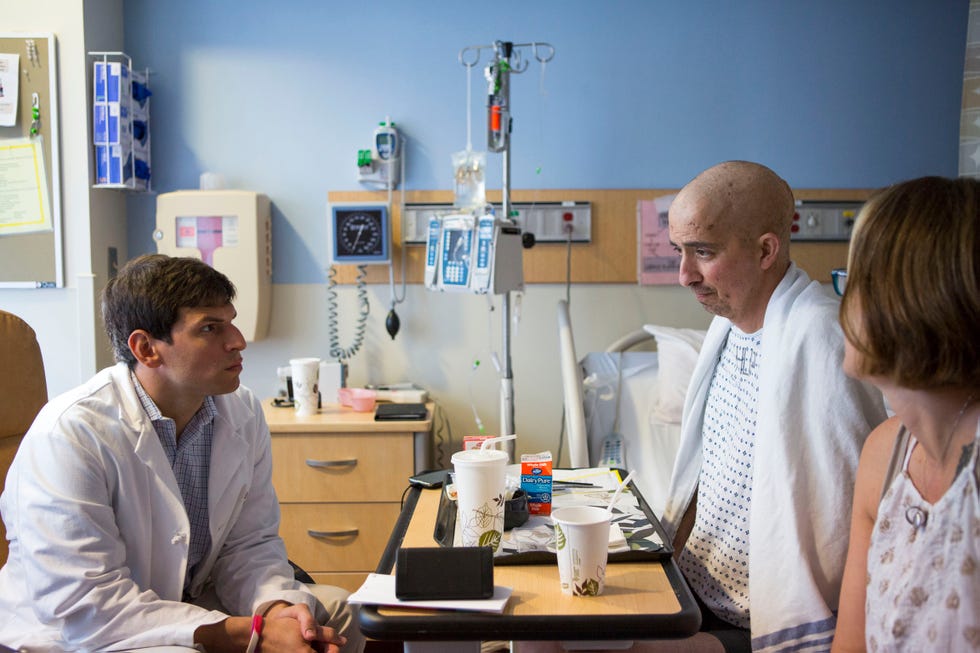
David with a Castleman disease patient he helped with a repurposed drug in May 2016.
“Every Cure doesn’t have a specific set of diseases or drugs it’s looking at,” David says. “All drugs and all diseases are within our scope. Which means that we get to be the one entity in the entire biomedical system that’s just looking for low-hanging fruit. What drugs could help what people? That’s it.”
He also runs a lab at Penn that’s similar to Every Cure but more specific: It focuses solely on finding repurposed drugs for a specific group of rare diseases called hyperinflammatory cytokine storm disorders (and primarily Castleman).
Every Cure employs about 50 people and has received both private and federal funding, the latter through the Advanced Research Projects Agency for Health (ARPA-H), established in 2022. The Penn lab employs about 15. They do both wet-bench research—in a lab, testing human tissue, cell lines, and other biological matter—and computational research, using machine learning. At both centers, they sometimes find matches that don’t make much sense. “Sometimes they really don’t make sense, because AI is not perfect,” David says. Other times, something that might seem at first like a glitch turns out to be real, or at least promising. The use of lidocaine, the topical local anesthetic, to inhibit tumor growth and metastasis in breast cancer was one—it sounded unlikely, but it cleared clinical trials and now it’s in use. And one of the highest scores the platform ever spat out was for Botox as a treatment for major depressive disorder. It scored 0.9999, about as close to a perfect score of 1 as a match can get.
“We were like, Botox for depressive disorder? And then we looked into it, and it turns out that glabellar injection—Botox right between the eyebrows—has clinical data suggesting three to four months of potential improvements in mood and reduction in major depressive disorder symptoms,” he says. “That doesn’t mean that it’s a cure or that it’s rock solid, but the algorithm gave it a high score. It found this thing that needs to be studied more closely. So, yeah, there’s stuff like that. It’s so cool.”
A high score from Every Cure’s AI platform is only the beginning of the work. Every match requires additional lab study before it can be tested clinically, which can take a few years. Then, if a drug is approved for the new use, it must be publicized to doctors and patients. To research and develop a single drug and get it approved by the FDA, a pharmaceutical company can easily spend hundreds of millions of dollars or more over 10 or 15 years. Its reward—in addition to helping people, of course—is a patent. But in the United States, medicines don’t receive lifetime patents. Eventually, every drug can be produced generically, and the company that invented it has no more incentive to advertise it because there’s less money to be made—patients and doctors can now just buy the generic version.
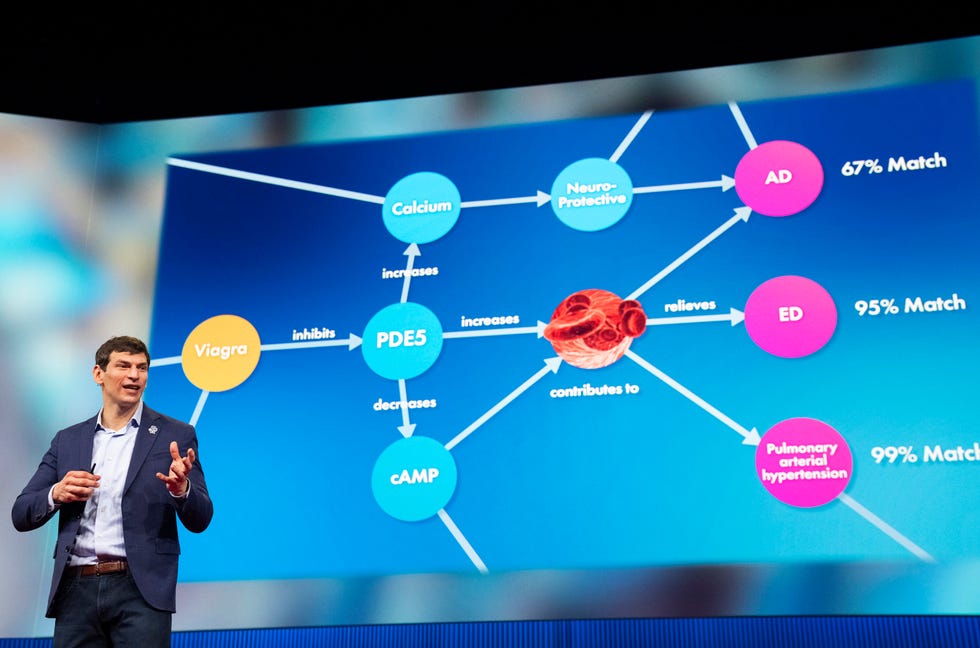
David giving a TED Talk in Vancouver last year.
“Drug companies are really good at raising awareness about drugs that are on market, but once that drug becomes off-patent, then they have no interest any longer, so there’s no entity that’s driving it forward,” David says. So, part of Every Cure’s mission is publicity, using tools like physician networks and patient advocacy groups when they need to spread the word about a new repurposed drug.
Over the years, David and his team at Penn, along with the CDCN, have discovered 14 new uses for existing drugs—medications that have been sitting on shelves behind pharmacy counters that could have been helping thousands of people suffering from diseases entirely different from what the drugs were developed for. Now, through Every Cure, they are actively advancing 10 repurposed treatments and review 1,000 different drugs for 1,000 different diseases each month. The organization has set the goal of being able to treat 15 to 25 more diseases with repurposed drugs in the next five years.
“If you spend your career doing biomedical research and you’re fortunate enough to be a part of developing just one brand-new drug for a disease, that’s an amazing career. That is huge. Very few will ever get that chance,” David says. “I’ve never been a part of developing a brand-new drug, but I’ve been a part of repurposing 14. And if you ask patients do they care whether the drug is new or old, we don’t care at all. Like, does it work? Was it made for organ transplantation? I don’t care! Is it helping my Castleman’s? Great!”
David’s own path to discovering sirolimus—one patient with one horrible, rare disease searching desperately for a drug—was the blueprint, but it is not the business model for Every Cure. Instead of working one patient at a time, they’re looking to make the easiest connections first. That’s not so Every Cure can make more money—it’s a nonprofit; it doesn’t make any money—but so that it can help more people more quickly.
“We could have gone the path of, Let’s make Every Cure a last-chance stop, a Hail Mary nonprofit where we’re here when you’ve got nothing else and we’re going to try to find a drug for you,” David says. “That was one option. We went with another option, which is that we’re going to look for the best opportunities out there to repurpose drugs, so that way you don’t need to throw a Hail Mary. So we can find a drug for something like Bachmann-Bupp syndrome so that kids that have it get treated early on and we don’t have to worry about a Hail Mary when they’re later on in life.”
It was the right way to go, of course. It’s also the part of this new life that David struggles with the most. He was one of those last-chance, Hail Mary patients. He had more last chances than most people get, and since publishing his book and later starting Every Cure, he receives emails from people all over the world pleading for him to take on their rare, so-far dead-end cases. And now he has to tell some of these folks that he can’t help them. Every Cure has been able to help thousands of people because it searches for matches to diseases, not to individuals. If it went person-by-person…what if there wasn’t a drug out there to repurpose? What if it didn’t exist? In his case, what if there had been no sirolimus? He wouldn’t still be here. But there was, and he found it, and now thousands of other people are still here, too.
“We don’t own any drugs,” he says. “The only reason this thing was made was just to help people. That’s it.”

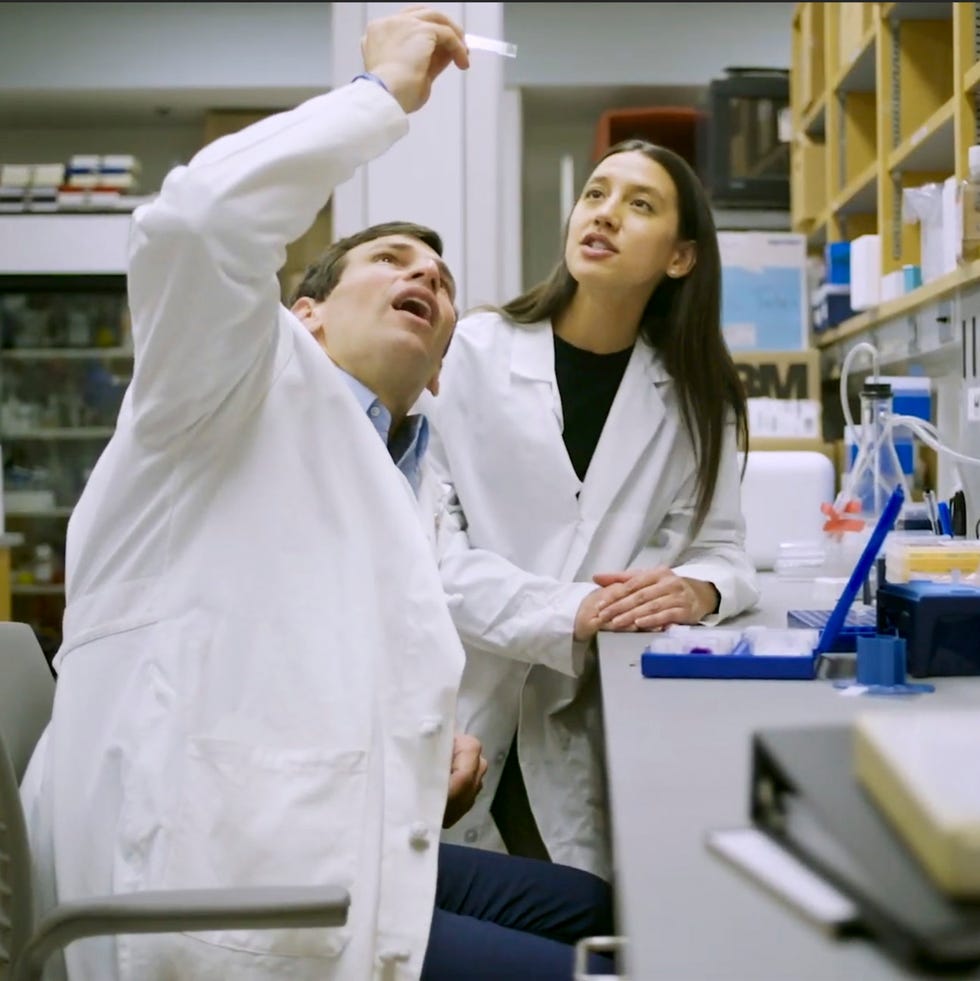
David in the lab with Every Cure cofounder Tracey Sikora in 2024.
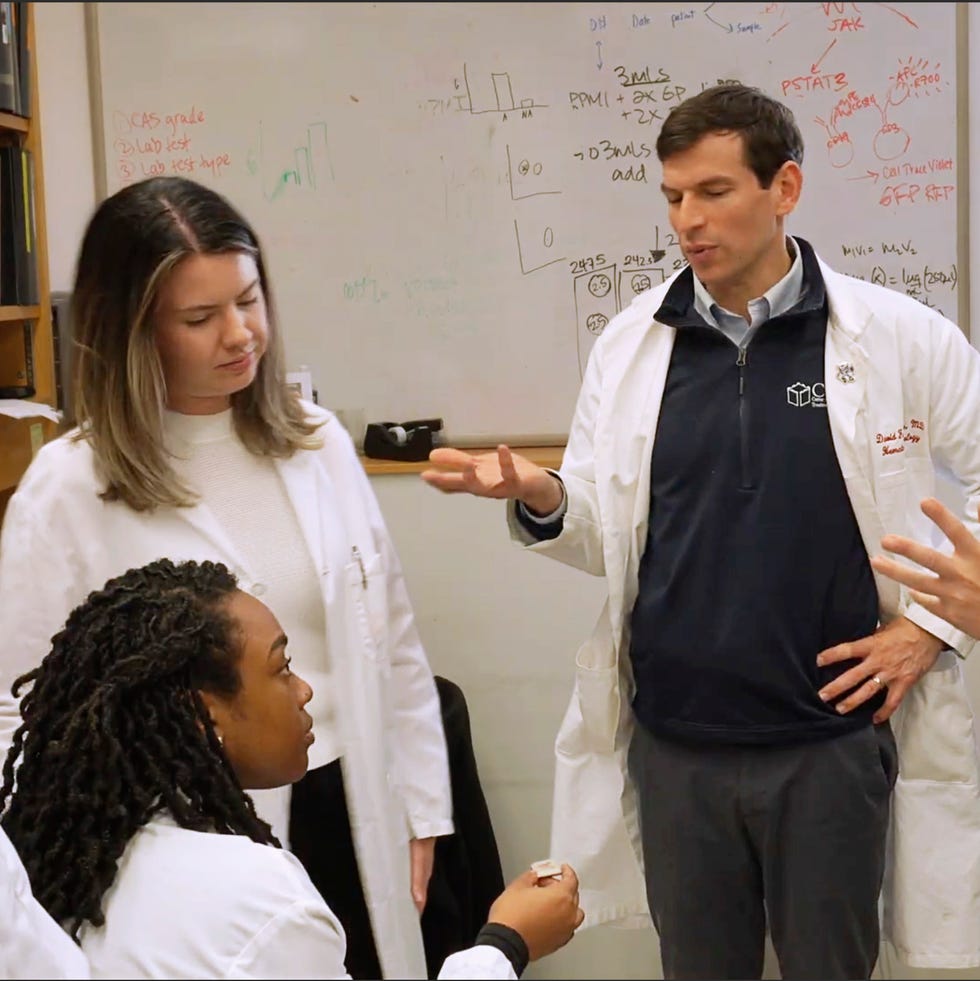
Him in the lab with his University of Pennsylvania team.

IT’S GOOD TO be David Fajgenbaum again. His children get just about every minute of his time when he’s not working. Some mornings he can squeeze in a workout before his first calls of the day. He doesn’t work out like he did when he was the Beast—he says he’s a shell of the physical being he once was—but it’s what he can do. He’s in the office and the lab every day, answers emails at home, gets calls while he’s with his family, and travels most weekends to speak at conferences and to corporate groups and at universities and to anyone who will listen to him talk about the urgency of what he is doing.
Caitlin books his speaking engagements—recently there were four in a single month, all over the country, and they looked at each other, not sure which one of them should say it was too much. “But there’s always one person in the audience, somehow, who reaches out—and David comes home and says, ‘It was worth it,’ ” Caitlin says. “ ‘That’s why that person needed to hear me, that’s why I had to do this.’ And—well, I do think he needs to slow down. We’re going to work on that. TBD. Maybe in 2027.”
As the Beast he ate grilled chicken with the skin peeled off, with steamed vegetables on the side. At one point, he hadn’t eaten a hamburger for 10 years. He does now, sometimes, because life is for living. He might have a drink or two a month. When he’s talking about all this, he smiles and hangs his head, almost embarrassed, then says: “I mean also, you know…cobbler.” He bobs his head a little, really smiling. “Some sort of a berry or fruity cobbler. That’s my other one.”
Caitlin says today he’s quicker to act than when she first met him, because he now knows that time spent planning could be time spent trying new things. “His motto since he got sick is ‘Think it, do it,’ ” she says. “It’s like a lightbulb in his brain that he can’t turn off. He’ll wake up in the middle of the night, thinking about an idea, and then he tells me he was up for hours thinking about this thing and he’s like, ‘Why couldn’t I just fall back asleep?’ His brain does not shut off.”
It turns out the question is not “What are you going to do?” It’s “Who are you going to be?” Sometimes we ask ourselves this question after a milestone—we turn 40 or 50 or 60. We get divorced. We get married. Or sometimes it’s after an unexpected event—the car flips and we somehow survive. We promise we’re going to make the most of the time we have left. Sometimes it lasts, usually it doesn’t.

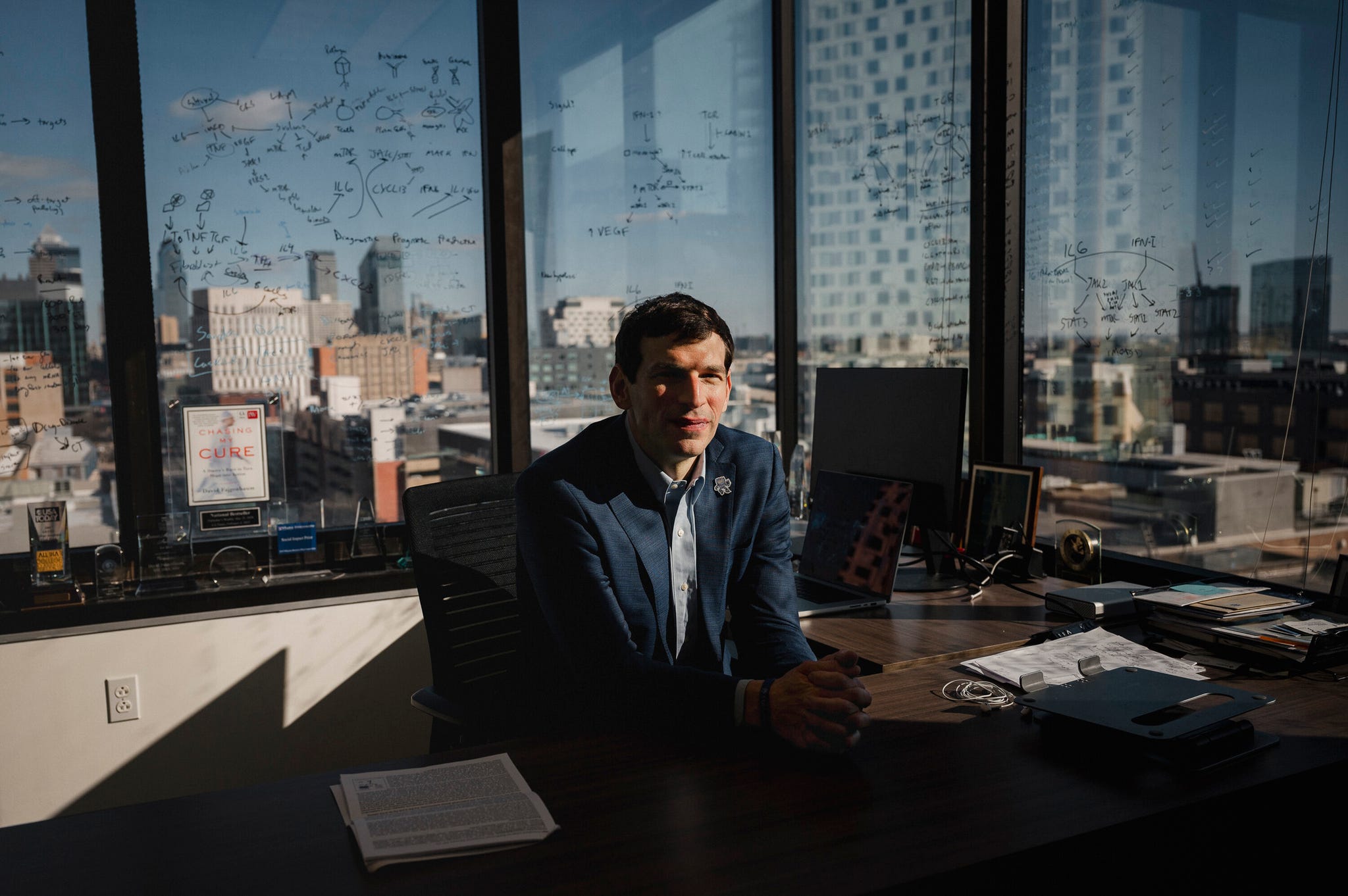
David Fajgenbaum almost died five times. He is not messing around. The drug he found has been working for 12 years, but he says using the word cure makes him uncomfortable. Why is he alive? Well, he’s alive because of sirolimus. But, big-picture. Cosmically. Why is he alive? Is he alive so he can use his singular, extraordinary experience to find cures for other people? Or is he alive to raise two good people with his wife? He has decided the answer to both is yes. After getting sick he lives what he calls a larger life. It’s wonderful, and hard. The travel, the long hours, the patients he can’t help, the kids crawling into the bed. But he doesn’t get up every day deciding what he should do, because he has already determined who he should be.
He was talking in his office the other day about a patient for whom he had helped find a medication that worked. The man had walked his daughter down the aisle a few months before. David just shook his head. He, too, dreams of that day for himself, a man who, according to the laws and probabilities of medicine, shouldn’t even be here.
But he is.

Ryan D’Agostino is Editorial Director, Projects at Hearst, and previously served as Editor-in-Chief at Popular Mechanics and Articles Editor at Esquire.
Read the full article here


