








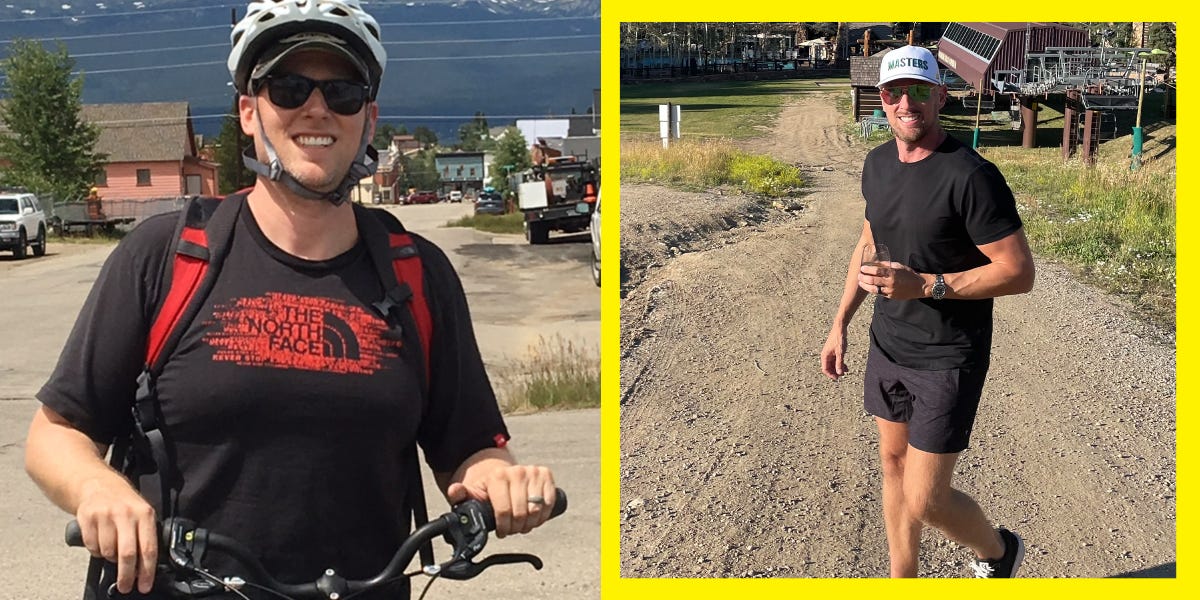
Stephen Sanders, 45, a physician from Destin, Florida, was running on fumes. His busy medical career left him no time to take care of his own health, and it led to his weight creeping up on him. A random photograph where he looked unrecognizable was the lightbulb moment to reevaluate his life choices. Below, he talks about his “boring” but “consistent” plan that helped him lose 60 pounds in 15 months.
MY WEIGHT GAIN was a slow and silent accumulation. I was working brutal shifts, running a medical practice, and raising a family. I was constantly in survival mode. I had a running list of priorities, and my health wasn’t one of them. I wasn’t tracking calories. I wasn’t making time for exercise. Meals were whatever was fast and convenient. As a physician, I understood the science of weight gain, but understanding something and living it are two very different things. My weight crept up five pounds at a time.
In 2019, I was 39 years old and I weighed 261 pounds. Seeing that number on the scale was jarring. I felt awful. My energy was also wildly inconsistent. I would crash in the middle of the day, then lie awake at night. Cognitively, I felt foggy, like I was operating at 50 percent of my capacity. When I looked in the mirror, the person staring back didn’t match who I believed I was on the inside.
My lightbulb moment was also a brutal one. I was in my late 30s, biking in Colorado, one of my favorite things to do in the world. Someone took a photo of me and when I saw the picture, I had to do a double-take. I literally did not recognize myself and it shook me to my core that this was the man I had become.
The hardest part of this realization that I let myself go was the quiet shame. I’m a physician and I counsel patients on their health every single day. I’ve sat across from thousands of chronically ill patients. I’ve watched what happens when metabolic dysfunction goes unchecked. Heart disease, diabetes, and the list goes on. I knew exactly where the road of obesity leads. In that moment, looking at that photo, I realized I drove myself into that route.
I decided right then and there to rebuild myself, treating it like a job because in many ways, it was. If I couldn’t optimize my own health, I had no business telling patients how to optimize theirs. That single moment launched a wellness journey I’m still on today.
I Prioritized Protein in Every Meal
WHEN IT CAME to nutrition, I followed an incredibly simple structure. I cut out all processed foods, eliminated liquid calories entirely, incorporated 18 hours of intermittent fasting daily, and ate the same meals on repeat, day after day. Prioritizing high-protein foods removed the guesswork of what to eat.
An example of lunch was grilled chicken or tuna over greens with olive oil. Dinner was a lean protein like salmon, tuna, or chicken with roasted vegetables. Snacks were typically either Greek yogurt or a protein shake. That’s it. People tend to want a sexy diet plan, but I learned that boring and consistent wins every time. I used the same food containers, prepped the same meals, and removed every decision point I could. I set out to create a foolproof system for myself that worked with my lifestyle.
Initially, I tracked every calorie using an app, which was a game-changer for me. People tend to underestimate how much they are actually consuming, and I fell into this category. I kept my protein intake high, using the metric of one gram per pound of target body weight and built every meal around that number first. Portion control wasn’t about willpower anymore.
Sleep and recovery became sacred during this process. I protected my seven to eight hours of rest. Additionally, I walked a minimum of 8,000 steps daily, rain or shine. No exceptions. I found that when you remove the external noise and focus on the basics, the body responds faster than most people think.
I Started Scheduling Exercise as an Appointment
WITH EXERCISE, I started embarrassingly small. My first workouts were basic full bodyweight circuits and 15 to 20 minute walks on a treadmill. No ego. No comparison. Initially, my only goal was to show up consistently and make it through the session.
I was guilty of believing motivation would arrive and keep me going in the process. What really kept me going was building habits and discipline and connecting them to my new identity. I stopped telling myself I was “trying to get in shape,” and started telling myself I was the kind of man who trains and doesn’t skip workouts. I put exercise in my Google Calendar like a patient appointment. I wouldn’t skip a patient appointment, so I wasn’t going to skip out on myself.
Strength training became my anchor. I started with two to three sessions per week, typically consisting of full-body resistance training and cardio. Eventually I worked up to six sessions at my peak. Sessions typically consisted of cardio and full-body resistance training. I wasn’t chasing aesthetics—I was trying to rebuild my metabolic engine.
I Found Hormone Imbalances That Fueled My Fatigue
ANOTHER UNEXPECTED FINDING was what was going on inside my body. Despite my healthy changes I still struggled with fatigue, reduced mental clarity, and slower recovery. When I eventually got labs and bloodwork done, I found my testosterone was significantly low. As a result, I started testosterone replacement therapy. It was definitely a turning point and a harsh reminder that you can’t out-discipline a hormonal deficit. If your foundation is broken, no amount of willpower will get you where you need to be.
How I Look Like Now
AFTER TWO TO three weeks, I felt better. After a month, I started to look different. After three months, people started asking what I was doing. I was beginning to feel better than I had in years, and I was becoming the man I always knew I could be.
I lost 60 pounds over 15 months, going from 260 down to 200. The first 20 pounds melted within the first two to three months, mostly from eliminating processed foods, liquid calories, and increasing physical activity. The middle phase was slower and required more precision with nutrition and progressive overload in the gym. The last 10 to 15 pounds were the toughest and slowest to lose.
How do I feel now? Like a completely different human. My energy is steady from morning to night. My cognitive and mental clarity is razor-sharp, like it used to be. I’m a better father, a better physician, and a better man. I’m 45 years old and finally in the best shape of my life. And I’m not done yet.
My next major milestone at some point in the near future is competing in the Leadville Race Series in Colorado, one of the most grueling endurance events in the country, at over 10,000 feet of elevation.
My advice to anyone wanting to make their own weight loss transformation would be that no one is coming to save you. Stop waiting for motivation or some magic solution. Habits and discipline are what get you to the gym on the days you don’t feel like it, and those are the days that matter most. Build your system, protect your routine, and show up even when it’s ugly.
The body is remarkably forgiving when you give it what it needs. Start today. Start small. Just start. I’m living proof of this!


Lisa is an internationally established health writer whose credits include Good Housekeeping, Prevention, Men’s Health, Oprah Daily, Woman’s Day, Elle, Cosmopolitan, Harper’s Bazaar, Esquire, Glamour, The Washington Post, WebMD, Medscape, The Los Angeles Times, Parade, Health, Self, Family Circle and Seventeen. She is the author of eight best-selling books, including The Essentials of Theater.
Read the full article here


