







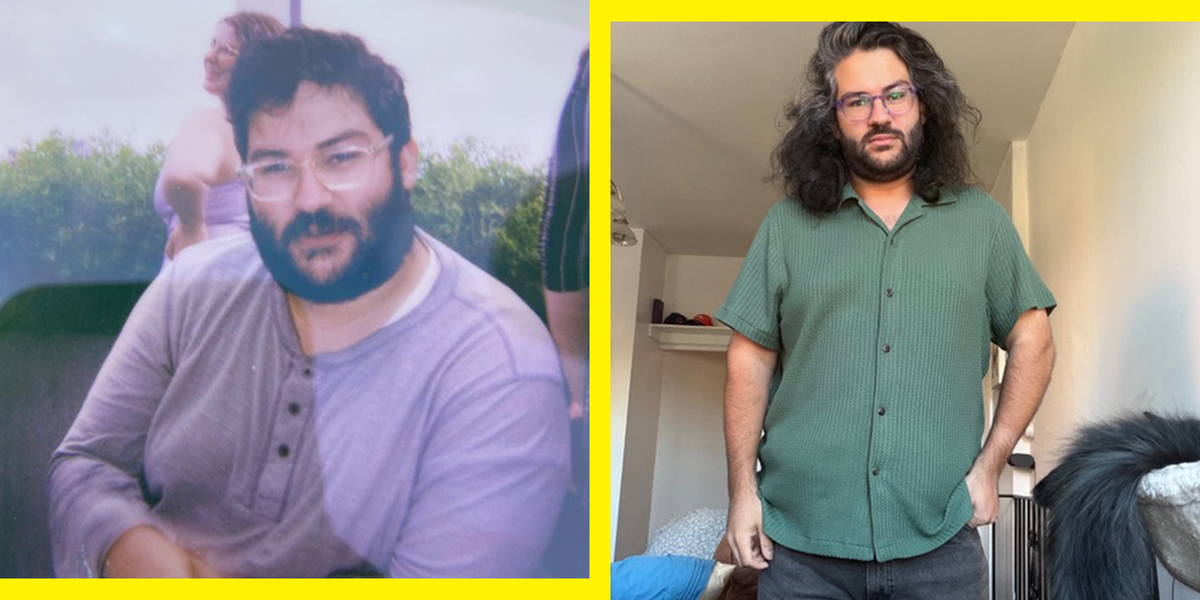
Mike Armory, 34, always turned to food for comfort when he was a kid. The habit, along with spending hours playing video games, caught up with him as an adult. As a therapist, Armory felt like a hypocrite for helping others make positive changes while struggling to take his own advice. A debilitating health issue finally propelled him to sit down and figure out a way to tackle his issues, both physical and mental. Here, he outlines how he lost 70 pounds and changed his life for the better.
MY WEIGHT GAIN started as a kid. I was pretty skinny as a young child, but started gaining weight after my mom got married and we moved to New Jersey. I was caught up in tensions between my mom and my biological father, who I would travel to see in Pennsylvania every other weekend. I also struggled to adjust to a new school. In hindsight now as a therapist, I can see that I had been developing depressive symptoms.
Food became an easily accessible emotional comfort. There were always plenty of snacks at home and second helpings at dinner. I spent most of my youth sitting down playing hours of videos and mindlessly munching on snacks. Video games and food became part of my identity. I also didn’t really have much guidance growing up about nutrition, fitness, and weight, which contributed to my poor habits.
I had periods in my life where I played sports regularly. However, the cliché is true: You can’t outrun a bad diet. I never looked at calories or macronutrients. I just ate what tasted good, which is a disastrous way of eating. If I felt depressed or bored, it was really easy to order thirty bucks worth of Taco Bell through Grubhub to temporarily feel better.
Despite eating lots of food, I had low energy. I always felt sluggish. I also didn’t like how I looked. I lacked confidence and I didn’t feel much pride in myself. I had goals to change, but I didn’t have the energy to fully pursue them.
At 31, My Weight Contributed to Several Health Problems
FOR DECADES, I’D used food as an emotional salve. It was my way of coping instead of addressing the issues with my mental health. The irony is that I’m a therapist now and I’m always keeping my patients accountable in the pursuit of their growth. Philosophically, I felt like a hypocrite for not walking the walk myself.
My lightbulb moment came when I weighed 321.6 pounds and kept injuring my feet. It got to a point where I was bedbound for weeks at a time. I developed sleep apnea, and had to use a CPAP. At 31, I was seeing my body break down in terrifying ways. I knew I was too young to see my quality of life dip to that degree.
I Started to “Budget” My Calories
I TRIED TO lose weight before, but it didn’t last long. I once went on a keto diet and lost over 50 pounds. Though I gained it all back—and then some after getting off the diet. My goal this time around was to create sustainable eating habits. That meant educating myself on calories and macronutrients. I also shifted focus from how tasty a meal was to paying attention to how different foods felt to my body.
Before, I would eat large portioned meals via takeout or delivery. I typically ordered an entree and an appetizer for each meal, and I’d do that two to three times a day. I suspect I was easily eating more than 4,000 calories most days.
To keep track of how much I was eating, I started using a calorie calculator. It also helped me plan how much weight I could reasonably lose in a year. I aimed for one pound a week, and I broke that down into monthly and weekly goals.
To plan my portions, I created a “calorie budget” for myself each day. Imagine a financial budget. I calculated how much calories I had to “spend” for the day. It was up to me to figure out how to spend them, but I had to stick to my budget. Now I had some days where I overspent, but then I made up for it by going under budget the next day.
My diet shifted from fried foods and processed meals to eating more veggies, healthy carbs, and proteins. I started paying attention to which foods filled me up, like rice and grilled chicken. For my sweet tooth, I bought low-calorie candies, drank zero-calorie soda, and Gatorade. Those were clutch.
I Used Instagram as a Fitness Aid
WHEN IT CAME to working out, I started small. When my feet were healthy enough, I worked on walking more. Over two and a half years, I went from 4K steps to 7K to over 10k steps a day! Not only did it do wonders for my mental health, it helped me create even more budget in my diet because it burned quite a lot of calories.
I motivated myself to walk long distances by setting destinations in mind. For example, I’ve lived in Greenpoint, Brooklyn for almost a decade, but I never felt like I’ve actually explored my neighborhood. My lifestyle before was sedentary. Walking gave me a chance to visit and connect with the people and places that make up my community.
Another motivator was posting publicly on Instagram once a week. I posted about my progress and wrote authentically about my experience. I shared what I was learning and kept it honest in areas where I was struggling. I wanted to keep it real. That meant not highlighting the success but showing people my failures and difficulties, presenting an honest picture of what it means to change your life. The feedback I got publicly and privately helped keep me going. People were rooting for me, and I felt seen.
It took me two and a half years, but I hit my initial goal of losing 70 pounds in early February 2025 after starting in October 2023. Specifically, from October 2023 to August 2024, I lost about 60 pounds. Some stressful events led to me going back up to 280. In early 2025, I lost 10 to 15 pounds, then plateaued in the low 260s/high 250s. In February 2026, my current weight stood at 248.9 pounds.
My Whole Life Is Different
I FEEL GREAT. My energy has substantially improved. My mood is much more stable and my confidence is much higher than when I started. I also feel more accomplished. I showed myself that I’m capable of doing difficult things over the long term.
I have a few more goals. I think it would be cool to get to 221.6 pounds and say I lost 100 pounds. However, I do feel quite content at my current weight, in terms of how I look and feel.
Still, the 100-pound goal is in sight. In the last six months, I’ve become addicted to biking. I even set a goal for 2026 to bike from NYC to Philly to catch a Phillies game. It’s over 100 miles and will require a degree of fitness that aligns with getting stronger and leaner. Another fitness goal is to work on weightlifting.
My advice to others trying to lose weight: try to incorporate other people into the process. Writing weekly progress posts was a fantastic experience that helped me feel accountable, and the feedback of others helped motivate me to push through plateaus or setbacks. Treat your journey as a true lifestyle change, not a temporary diet to abandon once you reach your goal. For me, it’s about evolving into a different version of yourself.
Most importantly, be kind to yourself. I believe losing weight is one of the most difficult tasks a person can take on in life. Treat it with a level of respect and seriousness. If losing weight is the fight of your life, it will require long-term dedication. Adapt as you go along, and always maintain a sense of passion, joy, and community.


Lisa is an internationally established health writer whose credits include Good Housekeeping, Prevention, Men’s Health, Oprah Daily, Woman’s Day, Elle, Cosmopolitan, Harper’s Bazaar, Esquire, Glamour, The Washington Post, WebMD, Medscape, The Los Angeles Times, Parade, Health, Self, Family Circle and Seventeen. She is the author of eight best-selling books, including The Essentials of Theater.
Read the full article here


