







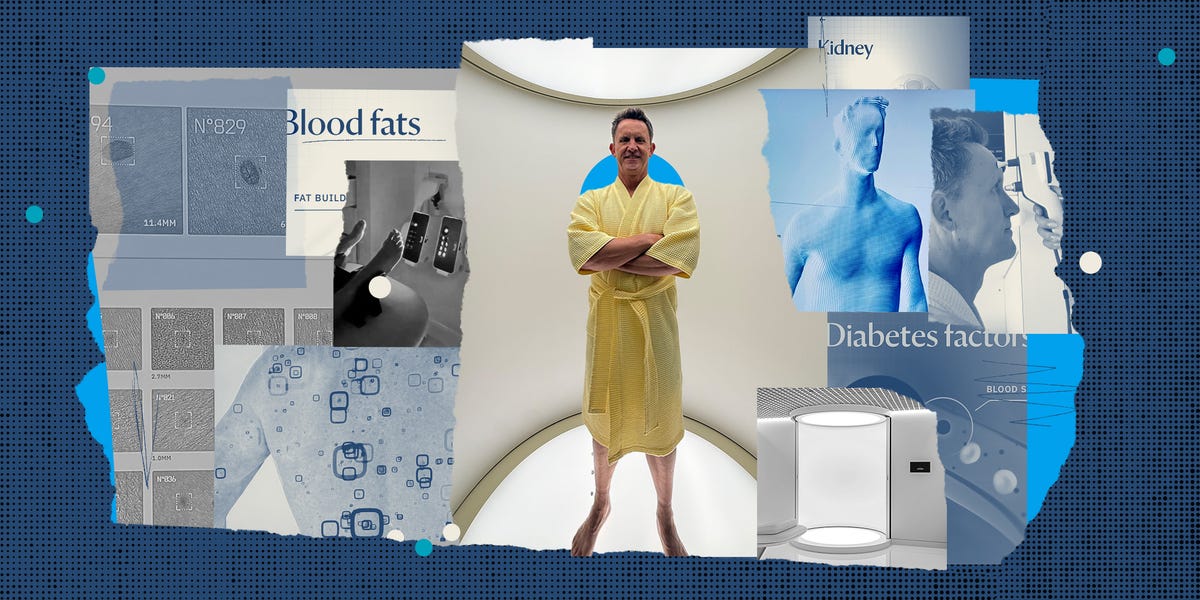
THIS IS UNLIKE any exam I’ve had at a doctor’s office before. I’m standing in front of an array of cameras wearing just my boxers, and a calm, disembodied female voice is giving me guidance: “We will start your scan by using 2-D, 3-D, and thermal cameras to create a detailed picture of your health from the outside.” Moments earlier, an IRL “medical operator” had taken my Neko waffled-robe and slippers and ushered me through the sliding door of the cylindrical chamber. “It will be very bright for a few seconds, so please close your eyes. Initiating in three, two, one.”
I’m bathed in warm light and there’s a synth swell sound effect with a note starting off low, peaking, then dropping, signaling the end of the scan. Later, I’ll discover that 1,596 of my skin markings have been identified and photographed and all my moles mapped. It feels as if I could be in the sick bay of the Starship Enterprise, but I’m actually in Soho, New York City, at the first American outpost of Neko.

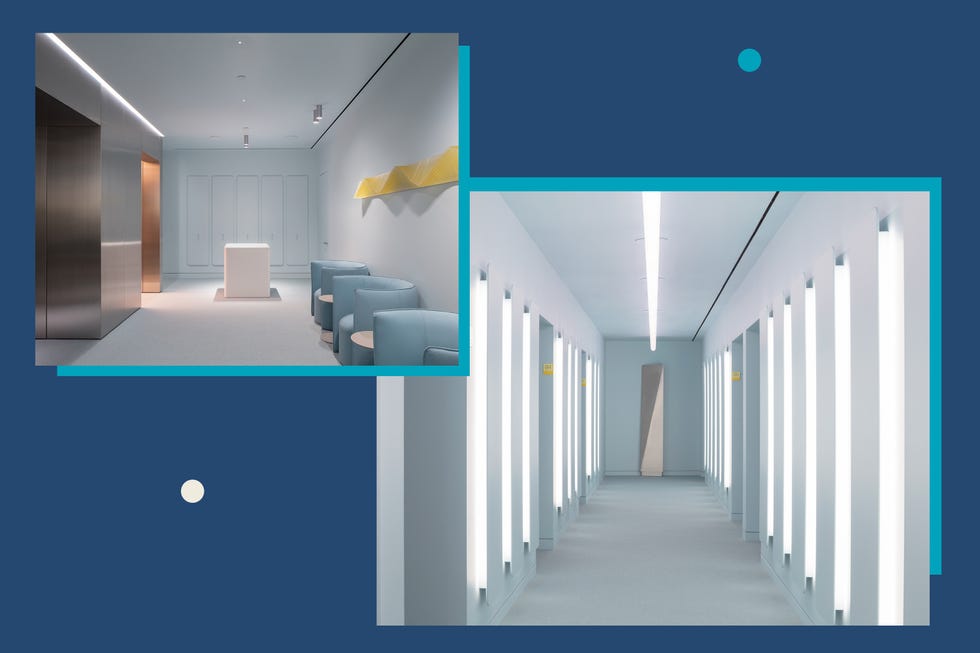
Inside the Neko Health Center in New York City.
The Swedish start-up, cofounded by Spotify creator Daniel Ek, joins a crowded and disjointed preventive health care space where various companies are addressing various aspects of wellness. There are genetic-marker early-detection cancer tests like Galleri, and MRI-based imaging platforms like Prenuvo; services that deliver biological age tests and blood-marker-focused health programs, like Function; places like Canyon Ranch that feature medical-grade longevity retreats; and many concierge doctors such as Peter Attia, MD, who offer exercise-forward lifespan-enhancing programs. All attempt to address the same fundamental question: Will additional data give you peace of mind—as well as clearer guidelines—about your future health?
Neko is different in that it combines various aspects of many of the other services—radiation-free imaging, blood work for 50 biomarkers, cardiac testing, time with an actual doctor, and an easy-to-use app—all in 60 minutes in a brick-and-mortar space. “We’ve spent the last few years asking a simple question: What if a single visit could give you a more complete picture of your health, where it’s heading, and a clear plan from a medical professional to change what happens next?” says Neko cofounder and CEO Hjalmar Nilsonne. Launched in Sweden in 2023, and also available in England, Neko now has more than 100,000 members who have done the scan. Approximately 75 percent of people who do it once sign up for another scan in 12 months, according to Neko. Soho is just the beginning of Neko’s U.S. expansion. The company plans to open other locations in New York City, followed by openings in Miami, Washington, D.C., and San Francisco over the next year.
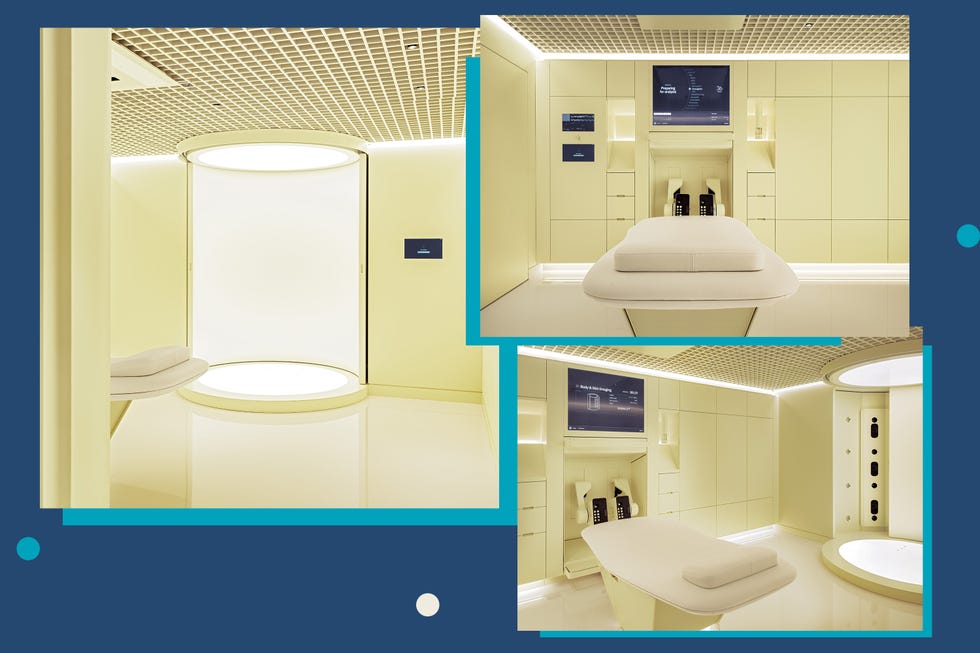
The exam room at Neko Health.
“Neko is a symptom of a market failure,” says Jordan Shlain, MD, a physician who runs Private Medical, a concierge health company with six locations across America. “Our health care system rewards specialty care because that is where the money is, and primary care—the part of medicine meant to know you and catch things early—has been starved for decades. Neko walks into that gap with beautiful technology and a one-hour visit, riding the wave of interest in prevention and longevity.” About the cost: It’s $499, approximately the same as a fancy steakhouse dinner for four or a quarter of the new Apple flip phone. I was about to find out if it would be worth it.
The Experience
THE SCAN INVOLVES eight elements and starts with “Body and Skin” and the 3-D body mapping. After that, you put on your robe and lie down on the treatment table for a “Blood Assessment,” which tests for 50 biomarkers. The human medical operator does the blood draw, and you can follow along on a flat-screen TV that displays where you are in the process. In a Jetsons moment, the blood vials are sent via pneumatic dispatch tubes to the onsite lab for analysis.

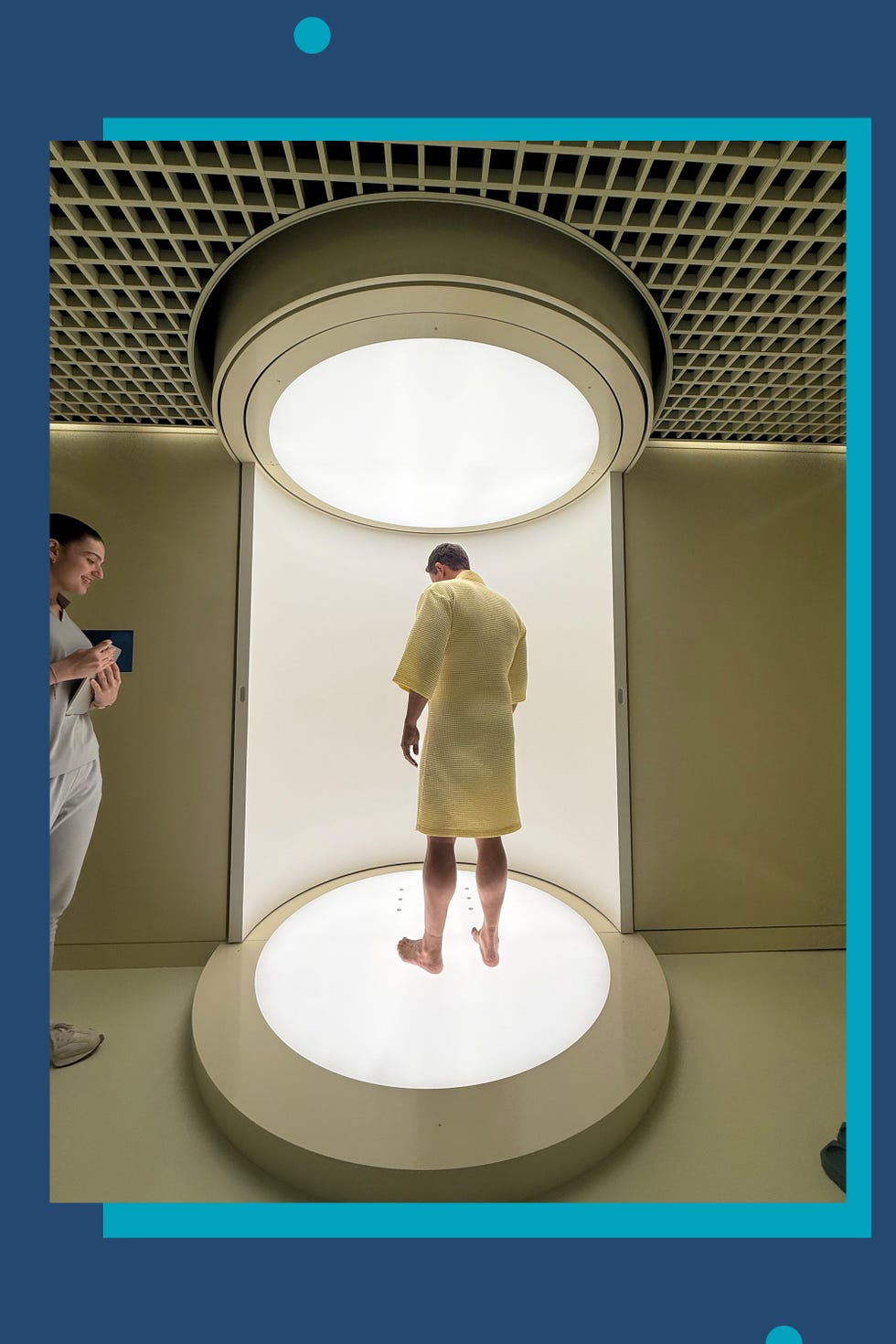
The author prepping for his body scan that maps moles and other skin markings.
Next is “4-Point Blood Pressure” (which tests at your biceps and ankles, if you’re wondering), then a “12-Lead ECG” to measure cardiac activity and heart rhythm. These parts are kind of standard doctor’s office stuff, but it’s semi-relaxing to be in a butter-yellow room and also lying down the whole time. The next two tests measure your circulation. First, the “Arterial Analysis,” which is done by a laser-radar assessing “macrovascular function” by evaluating the performance, efficiency, and mechanical health of your heart’s largest blood vessels and pumping pathways. (Don’t worry, you don’t feel anything!)
Then your feet take center stage for “Tissue Imaging,” in which a different laser assesses the microcirculatory function in your extremities by assessing blood circulation in your soles. (Also painless, but it does involve a cool green light.) The theory is that any signs of aging are first noticeable in the far reaches of your circulatory system—a canary in the coalmine scenario. Next were “Biometrics”: grip strength (which correlates with lifespan and is often used as a proxy for overall strength), weight, and body composition. Intraocular pressure is also tested, to assess potential glaucoma risk, and that was probably the awkward part of the scan because the operator uses a tool with a probe that briefly touches your cornea. It’s painless, but you blink a lot. Lastly, the onsite doctor joins the fun and listens to your heart with a stethoscope, then marks any suspicious moles for even more detailed photographs. All told, you’re done in about 40 minutes, and then you change out of your robe and go to the debriefing room.
My meeting was with Anirudh Bakhru, MD, and it took place in another butter-yellow room, where all the results were displayed on a flat-panel TV. One of the cooler aspects of the process is that as my results were loading, a pointillist avatar of me that’s kind of realistic-looking appears on the screen, hammering home the notion that this is personalized medicine. Dr. Bakhru reviews the results more or less in the order of the tests, highlighting any issues that need monitoring. The mole mapping is perhaps the most dramatic—it’s wild seeing your skin markings deconstructed into slides—and Dr. Bakhru said he wanted to send two suspicious-looking mole images to a dermatologist for analysis. (A few days later, I heard from the derm that they were fine.) This information all feeds into an app that’s easy to use, and now I have a baseline to monitor future changes.
My blood work, blood pressure, and cardiac data are similar to the results I received from a recent physical, although Neko’s algo computes a heart-age score that had me concerned. But Dr. Bakhru notes that with more consistent exercise, better sleep, regular stress management practices, and the strategic swapping out of red meat for white fish as often as possible, I can likely lower my blood pressure, reduce my cardiovascular risk, and lower my heart age.
Dr. Bakhru also recommended I drink no more than five alcoholic drinks per week because the blood tests revealed higher-than-recommended levels of two enzymes associated with liver stress. Dr. Bakhru also suggested various strategies that could nudge any scores I had in the “monitor” range to the “normal” range, and then elaborated on his recommendations in an “action plan” on the app. It was mostly exercise and diet stuff I already knew—I have worked at Men’s Health for a decade—but seeing the results and data matched so specifically to the suggestions gave them more weight. Dr. Bakhru also did some scary future-casting that predicted where my levels would be at age 80 without intervention.
The Verdict
OVERALL, MY NEKO experience was super positive. The choreography of the scan, the smart use of technology combined with human touches for some critical stuff, and the comfort and convenience of having all my data on an app that I can refer to in the future is enormously valuable to me. I didn’t learn anything radical about my health, but I do feel that I have greater visibility on the trajectory I’m on, and even if I can’t control everything, at least I have a better sense of where I’m headed. It’s definitely one of the more productive 60 minutes I have experienced.
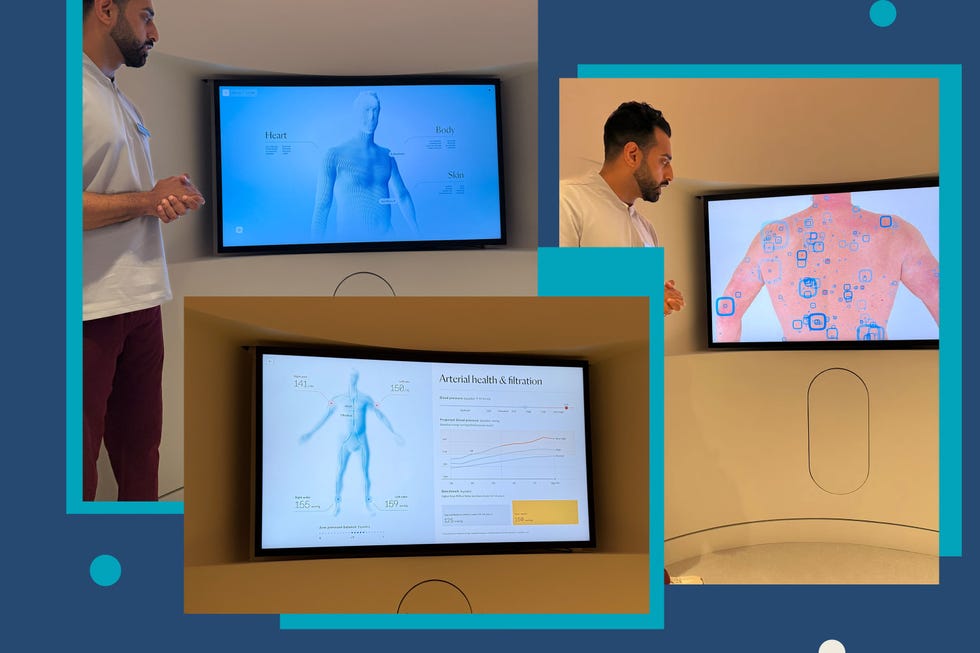
The author meets with Anirudh Bakhru, MD, and reviews his skin map and cardio data.
I also checked in with Dr. Shlain, the concierge doctor at Private Medical, for a second opinion. “The most innovative piece is the three-dimensional body mapping and mole tracking, with enough resolution to catch change from one year to the next,” he says. “The arterial and microcirculatory imaging looks at blood flow in ways standard care rarely does, and the software is legitimately good. The biomarker panel and the electrocardiogram are more conventional. Medicine already knows how to do those.”
For a third opinion, I talked to Keith Roach, MD, a New York City based internist and Men’s Health advisor for internal medicine. Dr. Roach cautions to “remember Theranos” (the bogus blood-work startup) and stresses the importance of Neko being transparent in how accurate its results are because some of the technology its using is new. While the blood work and 4-point blood pressure test rely on established methodologies, some of the other tests are either new or typically done by specialists and so sharing evidence that they’re effective is critical, he says. But Dr. Roach also says that services like Neko can be beneficial because they bring in people who might be reluctant to see a traditional doctor and identify health issues and funnel the patients to primary care physicians.
The Neko team was careful to stress that the service is not there to replace your PCP. Notably the Neko scan doesn’t test for prostate specific antigen and doesn’t include a colon cancer screening—two screenings that are recommended for guys over 45 (depending on your risk factors). “Finding something is only the first step, says Dr. Shlain. “Neko can help with follow-up and referrals, but someone still has to guide you through what comes next: which specialist, how urgently, which tests are worth doing, and how it all fits with the rest of your life. Data is raw lumber. Someone still has to build the house. So I see real promise in what they are building. I also see Neko as primary care adjacent. It works best as a layer on top of an ongoing relationship with a physician who knows you, not a substitute for one. Health care has humbled plenty of smart technology companies because it has more moving parts than anyone expects walking in. Neko has a chance to do something meaningful if it connects what it does exceptionally well with the long-term care that comes after.”
Would I do it again in 12 months? Yes, definitely. But I’ll also continue to see my PCP on the regular.


Ben Court is the Executive Editor of Men’s Health. He has a decade of experience writing and editing stories about peak performance, as it relates to health, nutrition, fitness, weight loss, and sex and relationships. He enjoys yoga, cycling, running, swimming, lifting, grilling, and napping.
Read the full article here


