








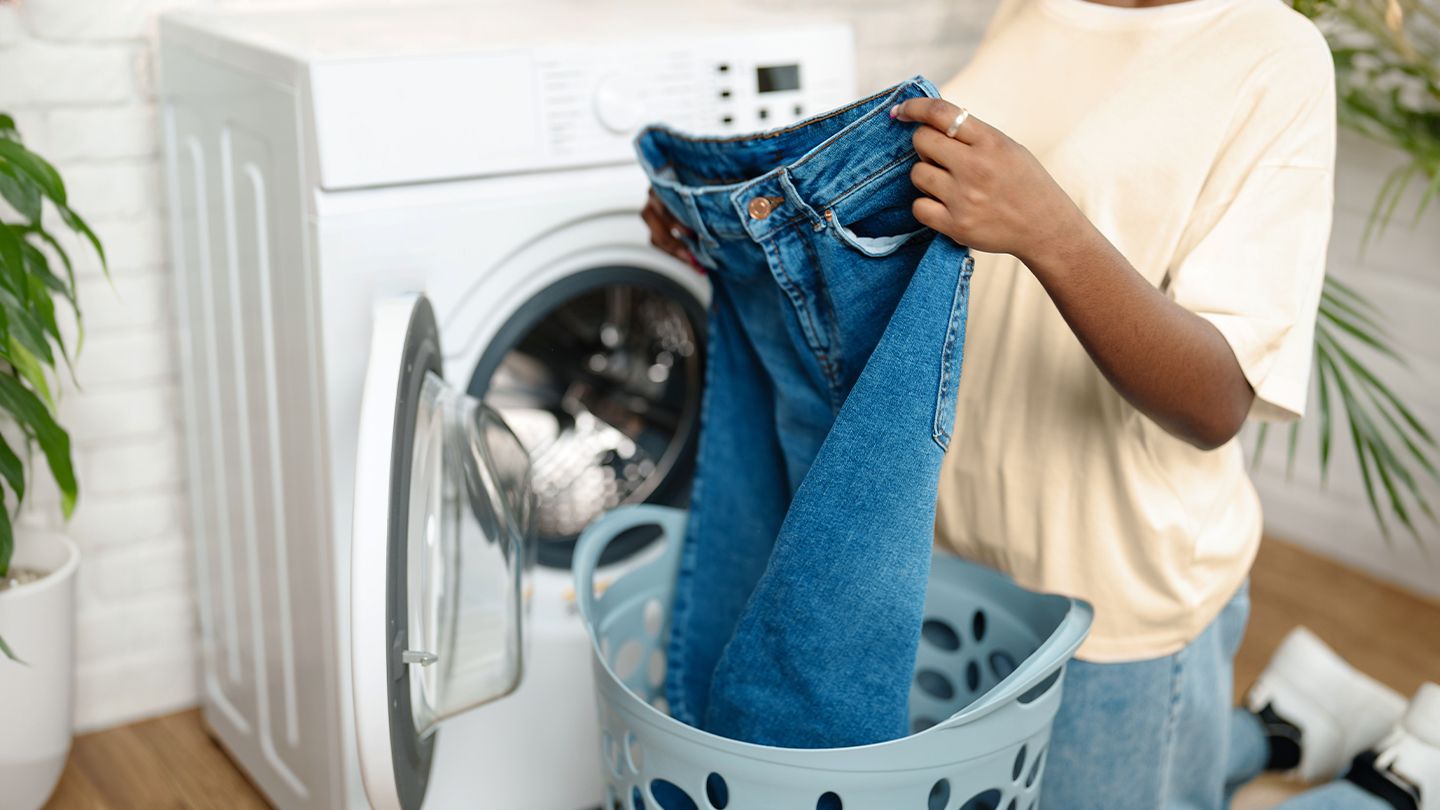
You might’ve heard that jeans don’t need to be — and indeed, should not be — washed after every wear. Laundering suggestions have ranged from washing them after every other wear or after several wears to even never at all.
When it comes to washing your denim, you want to strike that balance between maintaining its color and fit and keeping it clean. So what does that mean for how often you should wash your jeans? We asked a dermatologist and a textile expert for their takes.
How Often Experts Recommend Washing Your Jeans
There’s no one set of specific rules that dictate how often you should wash your jeans, says Erum N. Ilyas, MD, board-certified dermatologist and associate professor, clinical dermatology at Drexel University College of Medicine in Philadelphia. That’s because the frequency can depend on several factors such as:
- How often you’re wearing your jeans
- How long you wear your jeans each time you wear them
- Whether you sweat in your jeans
- The fit of your jeans (loose versus tight or somewhere in between)
- Whether you apply lotion or oils to your skin before putting on jeans
Sweat, skin-care products, and skin bacteria can all accumulate in your jeans, which is why it’s best to wash them regularly. Ilyas recommends washing jeans between every three and five wears.
Why It’s Important to Wash Your Jeans
Just like any clothing you wear, your jeans can get grimy. “Denim is still mostly cotton, although we are finding some more use of blended textiles that include an elastane to make it stretchier. This means that bacteria can absolutely attach to these fabrics,” says Dr. Ilyas. “The bacteria can embed itself into textiles and even form biofilms to resist washing if left unwashed for too long,” she says.
That said, the makeup of each brand and style of jeans can vary. To know exactly what’s in your personal pair, you’d have a sample of the fabric analyzed in a lab, says Karen K. Leonas, PhD, professor of textile science at the Wilson College of Textiles at North Carolina State University in Raleigh. Keep in mind that dirt and other grime can easily embed in the denim, which is enough to cause abrasion to the fibers and ultimately damage them, decreasing their longevity. “Laundering can remove some of those particles that are trapped in there,” she says.
In short: Washing your jeans is good for you — and your favorite pair of denim.
The Right Way to Wash Your Jeans
When washing jeans, there are a couple of things to keep in mind. First, avoid using hot water. “Detergent manufacturers reformulated most detergents decades ago, and they now clean effectively in both warm and cold water,” says Leonas. She uses cold water because it’s more environmentally sustainable than hot water. (Cold water uses less energy because your hot water heater does not have to heat up the water.) Powder detergents can be more abrasive compared with liquid, so stick to liquid formulations. And hang jeans to dry instead of tumble drying, she says; while hanging may make jeans stiffer and affect how well the fibers spring back into shape, it does preserve the fabric better.
Finally, there are some recommendations to freeze your jeans by putting them in your freezer for a certain amount of time to kill microbes that have settled into the fabric. Ilyas is dubious about this method: “I doubt most residential refrigerators could attain a deep freeze to impact bacteria — or just slow them down temporarily,” she says.
What Happens if You Don’t Wash Your Jeans Enough?
There are additional upsides to washing your denim. You know how when you wear your jeans, they can become baggy in places like the rear or knees? That’s the fabric stretching a bit to accommodate your body’s shape and how you move — all good things. If you want the fabric to go back to “normal,” throw your pair in the washer. Why? The cotton fibers that make up denim relax when in water. “This allows the fabric to go back to its initial shape and length,” says Leonas. For you, this will feel as if the jeans are smaller now (or better fitting), though they have not shrunk.
Read the full article here


