







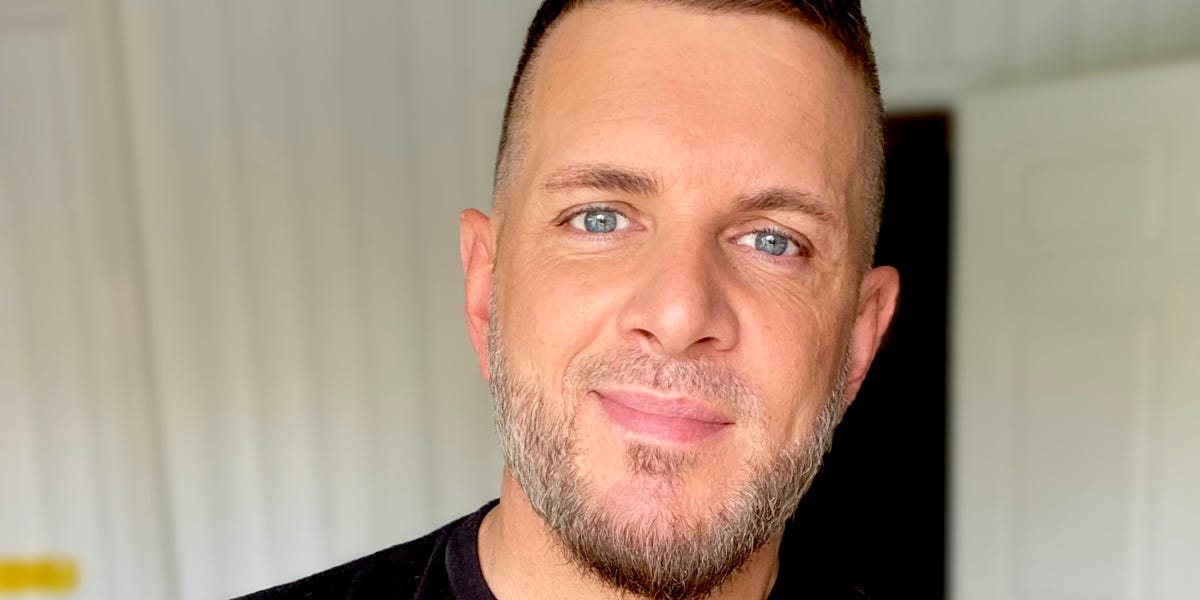
CONFIDENCE IS DISCUSSED so frequently and flippantly that its intricacies can get left in the shadows. When it’s lost, a cascading effect can take place, negatively impacting your relationships, sex life, physical and mental health, and even work. The tumbling of those dominoes can make it even harder to regain what was lost.
There’s value, then, in protecting your self-esteem. Jonathan George, a speaker and coach focused on confidence and self-worth, knows this firsthand. After he was diagnosed with Peyronie’s disease, he found himself putting the same lessons he teaches others into practice.
“I gotta live what I teach,” George says from his sun-drenched California home.
Peyronie’s disease, which affects roughly six to 10 percent of men ages 40 to 70, is a condition in which scar tissue forms under the skin of the penis. That plaque formation can result in a significant curvature as well as painful erections. The condition can be difficult to navigate, both physically and mentally.
One study found that men with Peyronie’s disease were more likely than men in the general population to be diagnosed with anxiety or depression. In earlier research, around half of men with the condition said it negatively affected their relationship with a partner.
For George, navigating the condition would require openness—and action.
When Something Felt Off
GEORGE, WHO HAS been married for 20 years, first noticed signs that something was amiss in 2025. “We were having intercourse, and I joked [to my partner], ‘You just broke my penis,’” he says. “It felt like something snapped. It hurt, but it wasn’t bad enough to stop.”
He later noticed the beginnings of what would become a roughly 30-degree curvature due to Peyronie’s disease.
“I know in some relationships, they’re not still sexually active with each other,” George says. “I get that. But we are. I’m 53. I’m not ready to stop having sex, you know? It was messing with my confidence.”
Between the discomfort during intercourse and feeling that the curvature was unattractive, George’s self-image took a hit. He didn’t notice right away how much it was affecting his confidence, partly because life can get busy and obscure incremental change, but it became harder to ignore as sex became more complicated.
“You’re going, ‘Oh, I can’t perform the way that I normally perform,’” he says. “It wasn’t just one time. It was a series of things: the positions didn’t feel good. I’m hurting. Mentally, I don’t feel attractive. Physically, I don’t feel attractive.”
Talking It Out
FORTUNATELY, GEORGE HAD experience to draw on. As someone who regularly guides others through self-doubt, he was uniquely positioned to bounce back after recognizing that his own confidence was lagging.
It helped, he says, that he has a supportive spouse and a relationship where no topic is off-limits. They were able to talk about what was happening to his body, exercises and options to reduce the curve in his penis, and what kind of changes were needed in their sex life.
“What’s there to be embarrassed about?” he says. “If I broke my arm, we wouldn’t be embarrassed to talk about it, right?”
Protecting the intimate connection he shared with his partner was another priority. “My dad was a pastor, and he counseled a lot of couples,” George says with an infectious smile. “I remember him telling me that great sex is 20 percent of a relationship, but bad sex is 80 percent of a relationship. That has always rung true to me.
“Sex plays a vital role in how we feel about ourselves and how we connect with our significant others. If you can’t perform and please your partner, it can easily mess with your head, especially if you’re not open about these things. It’s a snowball effect.”
Taking Back Control
THE TOOL GEORGE relies on most is simply taking action. “I’m somebody who teaches people all over the world about building confidence and doing what you need to do: the self-work, the mindset work, the physical work,” he says. “So I’m just taking care of myself.”
His first step was visiting his urologist, who recommended Xiaflex (collagenase clostridium histolyticum), an injectable treatment that can break up scar tissue and lessen the curve for many men. George figured he’d feel stronger mentally no matter how well the treatment worked.
“‘It’s not going to be a 100 percent [fix],’ my doctor told me, ‘but if we can fix it on a massive level, are you willing to do it?’ And I said, ‘Hell yeah. Let’s go,’” says George, who’s currently in the middle of his treatment plan. “For me, doing what I can gives me confidence.”
Peyronie’s disease is a physical condition, but a diagnosis can also bring unconscious, socially constructed assumptions about masculinity to the surface. “Somebody who’s proactive is very attractive, right?” he says. “What becomes very unattractive is somebody who’s not being proactive with their health. It’s like, ‘If you don’t care about yourself, why should I care about you?’ We care for those who really care for themselves.”
Caring for himself halted George’s growing self-doubt. “It’s the fact that I took action for my own self, for my health, for my well-being, and for my fulfillment,” he says. “That’s important. At least I know that I did something rather than just sit there and let things be and not know what was possible.”
Read the full article here


