








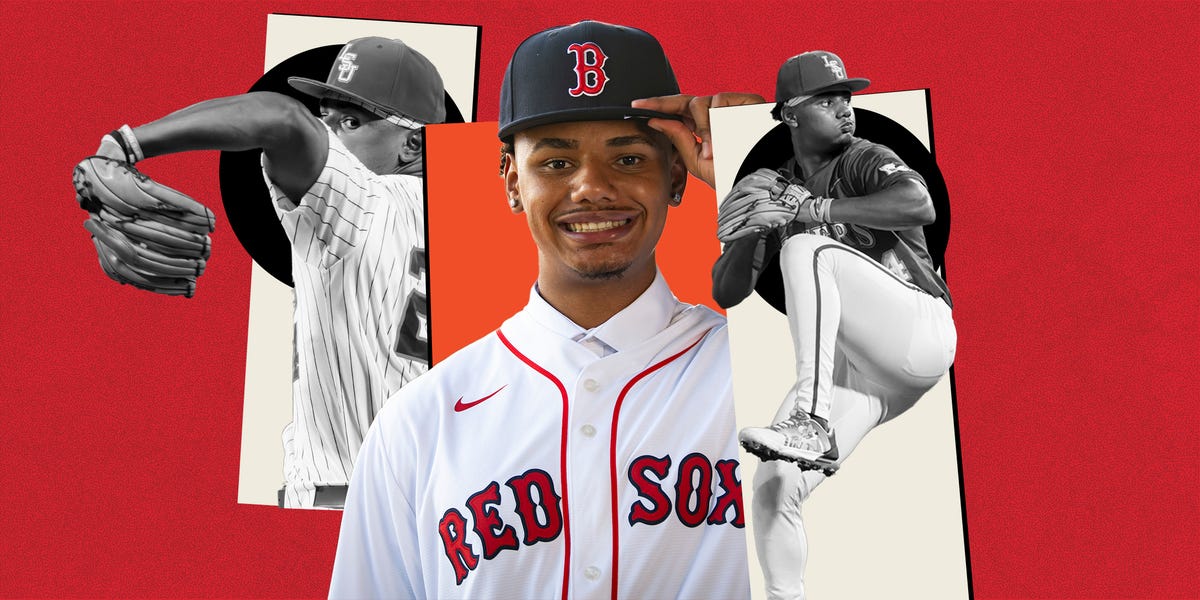
BASEBALL SEASON IS finally here, just in time for Anthony Eyanson to make his professional debut with the Red Sox. The 21-year-old already has a sizable reputation: After finishing third in Division I for strikeouts, he helped Louisiana State University clinch the national championship. He was also named First Team All-American in 2025.
Not that he needs it, but Eyanson is hitting the field with some extra motivation to crush it this season. He’s partnered with the National Eating Disorders Association (NEDA), and has said he’ll make a donation to the organization for every strikeout he throws. The money will fund eating disorder awareness and support, a cause he feels strongly about—in no small part because of his personal experience.
Before Opening Day, Eyanson sat down with Men’s Health to discuss his excitement on joining the Red Sox—and to talk publicly for the first time about his eating disorder. When he was 10 years old, Eyanson was diagnosed with a rare neuromuscular disorder called achalasia. It’s a swallowing condition where the esophagus does not properly move food from the throat to the stomach. This complicated his relationship with food in a way that led to disordered eating—all while training to become the star athlete we know today.
MEN’S HEALTH: How are you? Excited to be joining the Sox?
Anthony Eyanson: I’m really excited. It’s a childhood dream. I’m very blessed to be able to live it out in real life and just be there with my own two eyes.
MH: You’re here today to talk to us about your childhood struggle with achalasia, and the impact that had on your relationship with food. What did it look like in the beginning?
AE: These early symptoms for me looked like a lot of forced swallowing during and after consuming any type of food, no matter what time of the day. It almost felt like the same feeling you get when you have a nervous lump in your throat. Instead of it being relieved when I would swallow, it felt even more like my food was going to come back up until it eventually did. Along with this feeling, I would also have a lot of saliva that would build up after eating, causing me to have to constantly spit over and over because I wouldn’t be able to swallow at all.
Mentally, it felt like I was trapped in this dilemma of either nibbling on half of a meal and fighting to keep it down or going on with my day knowing that I was very hungry but unable to comfortably eat. Especially at such a young age, it was hard for me to find real happiness on a daily basis because all I would think to myself was, Will I ever be able to eat comfortably ever again? I just wanted to know that I was going to be okay and able to eat like “normal” again, so mentally I was stressing myself out because I had no idea what was wrong.
MH: What was your relationship with food like?
AE: With the eating disorder, it’s hard to think about all the different foods that were hard to consume. It was honestly a lot of foods. Rice was one of them. I remember eating a lot of rice, and that was pretty tough to get down and a lot of the bigger, solid foods. I remember eating a lot of mashed potatoes and soups.
MH: Jessica, what are some early warning signs that men with eating disorders tend to dismiss or overlook?
Jessica Scheer: There’s a big stigma out there around eating disorders, and who gets one. It’s not just skinny, white, affluent girls. Eating disorders do not discriminate, and athletes are at greater risk. People of color are at greater risk. If you are someone dealing with restriction or weight fluctuation issues, brain fog, that’s something everyone can identify easily as someone not quite performing the way they are and the way they would like to be. But there’s a whole list of emotional, behavioral, and physical signs of eating disorders.
MH: Anthony, how did the eating disorder affect your energy, training, and on-field performance?
AE: During my time with achalasia, my energy and recovery was at an all-time minimum. Waking up and skipping meals before playing two baseball games in the same day and then being unable to keep any food or liquids down made me feel extremely weak. I was constantly down in body weight, up late at night, and not getting a good night’s rest all because I would be hungry but mentally scared and worried about eating. My mood would swing a lot, and I tried to mask it when I was in public or around friends and family. Still though, there would be days where I would cry at home because I felt like a different person and wanted to be myself again. Surprisingly, my on-field performance was actually pretty similar to what it was before I experienced symptoms, but my body would feel very empty and exhausted. Towards the end of the baseball season, I felt so depleted to the point where I would even wonder to myself if it was a good idea to be playing in general.
MH: Was it hard to ask for help?
AE: Yeah, it was. For me, I was just embarrassed because I didn’t know what was going on, and I just didn’t want to be seen as different. I was only 10 years old when it started.
MH: Can we talk about the moment you decided to seek treatment?
AE: I went from 107 pounds to 75 pounds from May to July. I just wasn’t able to finish any food. It just felt, like, stuck in my throat. I had to, like, spit food up every time I ate. I just remember going to sleep hungry some nights because I was scared to eat. Because I didn’t really know what was going on with me.
It was a day where I was doing one of those ice bucket challenges in the backyard. I was 79 pounds, I believe. My mom had noticed that I was really skinny, and that’s when she had called my doctor and said that she thinks it’s something bigger than a normal sickness.
I was admitted to the hospital July 20th, 2015, and I was there for twelve days. I had four procedures done and a final surgery. And I was out of the hospital on August 1. I do remember one of my surgeries ended up being a Heller myotomy. That was probably the most nerve-wracking one, just because I had to go under anesthesia for surgery. And just being at that young age, you don’t really know what’s going on.
MH: How was recovery post-surgery?
AE: Post-surgery for me was a slow process, but it was well worth the wait. Right after the surgery, I stayed in the hospital for about 9 days before I was able to be back at home. I had no food for the first seven days, followed by small amounts of soft foods, like soups, mashed potatoes, and strained broths. When I ate these things, I remember anxiously waiting for that lump in my throat to pile up again where my food usually would—only to feel the satisfaction of my food passing into my stomach.
The doctor asked if the food had passed through okay. I remember I had tears in my eyes when I nodded, yes.
MH: And what are things like now?
I approach every day with confidence and optimism from what I had to overcome to get where I am now. As for eating, I tend to eat slower than a lot of my peers. All foods, no restrictions, and hardly have any problems at all. I am able to consistently eat and keep down 4 meals a day along with multiple liquids and snacks as well. Everything goes down okay. When I eat small foods that can build up when chewed, like rice, I have to take it slower and take smaller bites—but I am able to comfortably eat it. Other than that, I am very happy and blessed to have this recovery.
MH: As a pro athlete, how do you handle conversations about size, body composition, and diet?
AE: I’m very confident in those conversations. I’m very proud to have recovered from this. I feel like it’s made me who I am, for sure. So I don’t hesitate at all when speaking about stuff like that.
MH: Tell me more about the partnership with NEDA.
AE: I really wanted to connect to something bigger off the field. At first I didn’t really know how. I had a lot of ideas and a lot of inspiration from my teammates at LSU who would donate and give back. I knew I wanted to do something that was really important to me.
I’m just really excited to just have the extra motivation. It means everything to me.
JS: I just want to highlight how important it is that someone like Anthony is stepping forward. Athletes are at greater risk for developing eating disorders. Males in particular are 19 percent more at risk for developing them because of the pressures of what their body needs to do to perform for them.
MH: Can you tell me more about the support you have today?
AE: My support system is very proud of me. It’s a lot of people. Obviously, God first. Family, friends, the agency. Ryan has been clutch. In baseball, everybody that I’ve gotten to meet and know. They’ve been really great people.
MH: How do you feel about yourself today?
AE: Oh, man, almost like a superhero in my mind. I understand that everything in my life is going towards success with pitching. But there’s almost more motivation to take everything off the field and help there as well.
MH: What advice would you have for a guy who may be going through similar difficulties with food?
AE: Don’t be nervous to speak up. You’re one question away from finding the answer that you need. The more awareness that you can create, the more people that will help you along the way. So I think it’s really important to speak up.
MH: Beyond stats, what does success look like for you this season?
AE: It just looks like me being myself. Enjoying every step of the way, enjoying the journey that God has given me. And trying to bless people off the field as much as I do on the field.
This interview has been edited for content and clarity.


Jocelyn Solis-Moreira, MS is the associate health & fitness for Men’s Health and has previously written for CNN, Scientific American, Popular Science, and National Geographic before joining the brand. When she’s not working, she’s doing circus arts or working towards the perfect pull-up.
Read the full article here


