








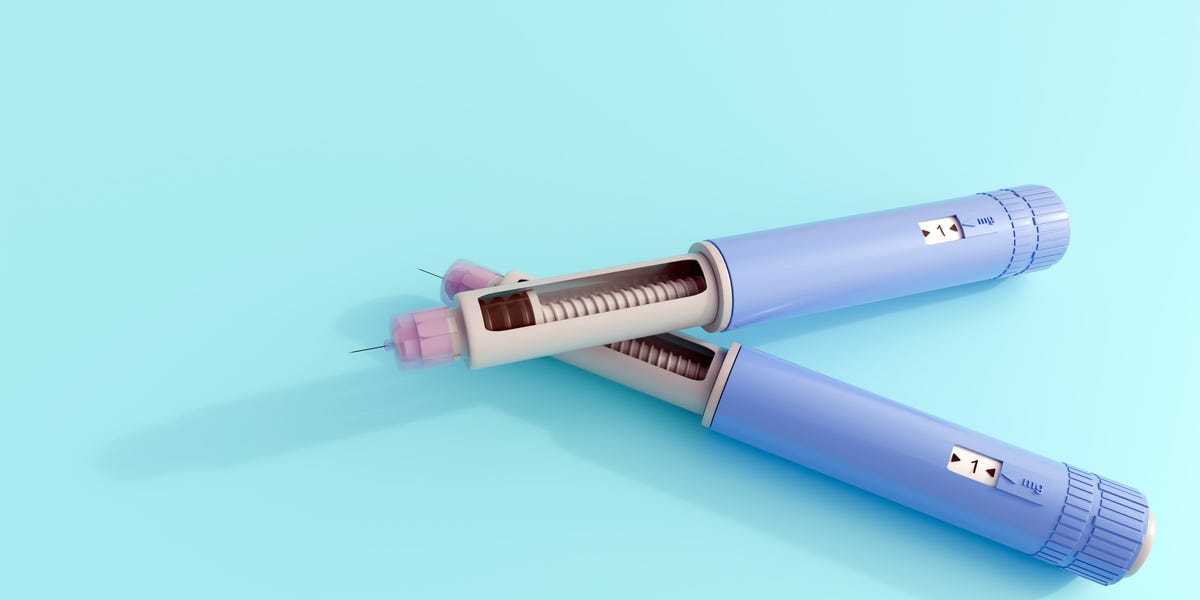
THESE DAYS, WHEN it comes to weight loss drugs, you’ve got a veritable buffet of options. Stick with the classics like Ozempic and Mounjaro. Don’t like needles? Try Wegovy’s new pill. Pop online anytime and get a compounded version of either. At the end of the day, whatever you choose is likely to work—just ask our readers!
So why, then, would anyone feel the need to introduce more? Why reinvent the wheel when all of our current options work? But that’s exactly what’s happening. CagriSema is the latest experimental GLP-1 variant to generate buzz—and drama—in the weight loss space. It works slightly differently than the other GLP-1s and is allegedly twice as powerful. (Extremely allegedly.) Novo Nordisk filed for FDA approval in December 2025.
What is CagriSema and How Does It Work?
CagriSema is a two-drug combo of semaglutide (you’ve heard of this one, it’s the active ingredient in Wegovy and Ozempic) and cagrilintide.
“It is a combination of a GLP-1 agonist and an amylin agonist,” explains Richard Siegel, MD, co-director of the Diabetes and Lipid Center at Tufts Medical Center and endocrinologist at Tufts Medicine Weight & Wellness Center – Stoneham. The drug works by mimicking the natural hormone amylin involved in increasing the time it takes for food to leave the stomach. Amylin also helps to regulate blood sugar levels.
If CagriSema gets FDA approval, Siegel notes it would be the first long-acting amylin agonist on the market.
The keyword here is if.
The reason behind the growing hype around CagriSema is that it is supposed to produce better results than existing GLP-1s. Early research data found CagriSema caused weight loss of about 21 percent of a person’s body weight. By comparison, semaglutide is linked to a 13.7 percent reduction. Tirzepatide (Mounjaro, Zepbound) is linked to a 20 percent reduction.
Sounds Good, So What’s the Problem?
A recent trial put CagriSema in a head-to-head challenge with Zepbound. Based on earlier data, there was a lot of expectation that CagriSema would come out on top. Except it didn’t.
This REDEFINE 4 clinical trial spent 84 weeks comparing the effectiveness of CagriSema versus tirzepatide (Zepbound) in 809 people with obesity. People who took a once-weekly injection of CagriSema lost around 20.2 percent of their body weight over the study period. However, those who took tirzepatide actually lost about 23.6 percent.
“The trial did not achieve its primary endpoint of demonstrating non-inferiority on weight loss for CagriSema compared to tirzepatide after 84 weeks,” reads a Novo Nordisk press release.
The doctors we talked to aren’t surprised. Tirzepatide regularly logs some of the best numbers among weight-loss medications. “Tirzepatide is a very potent medication,” Siegel says. “[CagriSema] was statistically worse, but still quite potent.”
The results still showed meaningful weight loss by patients given CagriSema. The numbers are also still higher than Novo Nordisk’s previous GLP-1 drugs, Wegovy and Ozempic. It just didn’t outperform Eli Lilly’s Zepbound in this case.
Mir Ali, MD, medical director of MemorialCare Surgical Weight Loss Center at Orange Coast Medical Center, speculates CagriSema won’t get as much traction if it does end up getting FDA approval. Ali says the current evidence is pointing to the likelihood that stimulating amylin receptors doesn’t do as much as the GLP-1/GIP combination that Zepbound provides. (Wegovy and Ozempic only target the GLP-1 receptor).
Mitchell Roslin, MD, chief of bariatric and metabolic surgery at Northern Westchester Hospital and Lenox Hill Hospital, agrees. “It really looks like a solid drug, but not the game-changer that people predicted.”
Revolution Is Still Possible
“In the future, we may be able to determine that a person is more responsive, based on genetics and other characteristics, to one medication vs another,” Siegel says. “It’s useful to have medications with different mechanisms of action on the market.” Best of all, he says adding more competition will likely drive down the price of of GLP-1 medications overall.


Korin Miller is a freelance writer specializing in general wellness, sexual health and relationships, and lifestyle trends, with work appearing in Men’s Health, Women’s Health, Self, Glamour, and more. She has a master’s degree from American University, lives by the beach, and hopes to own a teacup pig and taco truck one day.

Jocelyn Solis-Moreira, MS is the associate health & fitness for Men’s Health and has previously written for CNN, Scientific American, Popular Science, and National Geographic before joining the brand. When she’s not working, she’s doing circus arts or working towards the perfect pull-up.
Read the full article here


